Extraordinary Function and the Half-Diminished Seventh in the Song of the Wood Dove
Jill T. Brasky
KEYWORDS: chromaticism, Schoenberg, function, half-diminished seventh, Gurrelieder
ABSTRACT: This study considers the half-diminished seventh, a chord that, in post-Romantic contexts, often fails to yield to easy classifications because of the multitude of potential interpretations. The seventh is crucial to an understanding of Arnold Schoenberg’s “Tauben von Gurre!” (the Song of the Wood Dove), from the end of Gurrelieder’s Part I—a lush, tonal work that remained incomplete until 1911. In combination with the story’s three main characters, the seventh’s local and large-scale implications help to provide an interpretation that weaves its way through “Tauben,” Gurrelieder, and touches briefly on Schoenberg’s own life.
Copyright © 2010 Society for Music Theory
[1] In the years following the debut of the Tristan chord, a number of works have continued the dialogue on how half-diminished sevenths function. Arnold Schoenberg famously noted that “there has been great argument over the question as to which degree [the Tristan chord] belongs” (Schoenberg 1911, 309–310).(1) While Schoenberg acknowledged the debate and confusion in 1911, he also pointed the way towards a process of understanding: “...essential to us is the chord’s function, and it reveals itself when we know the chord’s possibilities” (Schoenberg 1911, 310).(2) Only recently have we taken Schoenberg’s words to heart and examined the various options inherent in half-diminished sevenths; only recently has our theoretical inquiry moved beyond elemental questions, allowing us to unravel the complicated musical contexts with which we wrestle.
|
[2] The passage in Example 1a comes from the end of “Tauben von Gurre!,” the last song in Part I of Schoenberg’s
Gurrelieder. Both the metrical placement and prolongation through the half-diminished seventh center the passage around the E |
Example 1. Gurrelieder, measures 1086–1088
(click to enlarge and see the rest) |
 or
or 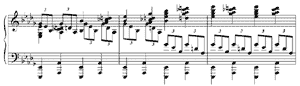
I. Introducing the Half-Diminished Seventh
[3] Relying on conventional theory to address the musical practices of late chromatic harmony can be problematic because, as Carl Dahlhaus observes, “the essential element in the association of chords is semitonal connection and not root progression...chromaticism has achieved a degree of independence from its origins in alteration” (Deathridge and Dahlhaus 1984, 199; Kinderman and Krebs 1996, 4). By now, the analytical tensions this repertoire causes are familiar: the harmonic contents are often unyielding to classification in fundamentally diatonic systems, while individual pieces create their own stylistic tendencies (Proctor 1978; Kinderman and Krebs 1996). While classic studies on chromaticism concentrate on formal shape, more recent scholarship provides analytical entry points into the details, focusing on seventh chords instead of triads, obfuscation instead of clarification, and tension rather than release.
|
[4] Charles Smith’s 1986 article on extravagant function considers chromaticism a combination of harmonic and contrapuntal motion (Smith 1986, 103–105). This perspective justifies a series of alternative dominants that replace the diatonic scale-step |
Example 2
(click to enlarge and see the rest) |
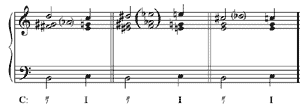
[5] More recently, Richard Bass describes how half-diminished sevenths cause us additional complications because we still consider them the product of linear motion when they occur outside their traditional contexts—that is, in forms other than vii 7 or ii7 (Bass 2001, 41). Consequently, the chromatic chords from Example 2a are habitually classified as irregular, embellishing, or non-functional, often because we are unfamiliar with how they operate (Bass 2007, 73). Bass creates two categories for our seventh. The first, a half-diminished augmented sixth, notates


[6] The first three chords in Example 2a resolve to C-major triads, where the
leading tones ascend to the tonic and dissonances resolve appropriately. On the second set of staves, the same sevenths resolve to C-minor triads.(8) In minor, the  add notational complexities to the voice-leading because they already exist as the diatonic
[7] We determine a sonority’s function by examining three elements: its context, root, and quality. Smith suggests our half-diminished seventh is a delicate dominant on the basis of its leading tone and context; both Harrison and Bass establish its similarity to augmented-sixth chords by placing some emphasis on its predominant moorings, without actually identifying it as such (Smith 1986, 124–126; Harrison 1995, 184–185; Bass 2001, 44). It follows that identifying this seventh by a root is bound to be troublesome. Like the family of augmented sixths—chords seldom identified by roots—giving the seventh a root is likely to further problematize it. The analyses that follow identify the half-diminished chord by its bass voice and function(s).(11)
[8] The seventh’s functional composition leaves us with the initial impression that it is a multifarious changeling. Its contexts tend to further support this confusion and are homologous to two kinds of standard tonic prolongations: expansion by plagal means and expansion via a dominant. As is the case in diatonic music, the context of an individual scale-step can have an impact on its function, and a scale-step can maintain connections to more than one function. Outlined in Example 1b, the chord’s functional possibilities do not provide a single, obvious designation. The neighbor ’s–– may also create a hint of dominant function.(12) That is, the we hear in V7 can be distinguished from the we hear as the root of a subdominant, and its interpretation in the half-diminished seventh is thus dependent on the chord’s context (Harrison 1994, 45–56). The
  in plagal relationships and
to the in dominant-to-tonic ones. As a result, the unchanging
in plagal relationships and
to the in dominant-to-tonic ones. As a result, the unchanging
[9] Bass lines are equally important to our understanding of harmonic function (Smith 1986;