When Music Theory Forgets Its History: How We Got into “Escape Tones,” and How the Past Can Help us Escape*
David Carson Berry
KEYWORDS: escape tone, échappée, neighbor suffixes, anticipations, prolongation, music theory pedagogy, history of Western music theory, organizational memory, Schenkerian analysis
ABSTRACT: This essay explores multiple issues related to the non-chord tone known as the escape tone. It is organized in four parts. Part I summarizes the escape tone’s reception and evolving understanding through a survey of textbooks from the 1880s to the present. An earlier conception of the figure—as an indirect anticipation of a subsequent chord tone (i.e., as an arpeggiation prefix)—is shown to have been once common but no longer cited. Over the decades, it was essentially “forgotten.” Part II focuses on general theoretical implications. It demonstrates problematic aspects of the current view of the escape tone, which defines the figure in terms of shape rather than function, relates the dissonance backwards rather than forwards, and promotes the idea of a “leaping resolution.” It also systematically investigates escape-tone possibilities, revealing that the figure generally operates in one of two ways with respect to what follows: it is either an arpeggiation prefix, as observed by the earlier textbook sources, or it is part of a compound-melodic figure in which the dissonance implicitly resolves by step. Part III focuses on more advanced theoretical issues involving prolongational analysis. It culminates in the possibility that a common way the escape tone is explained—as an incomplete neighbor suffix—may not be valid. Part IV concludes the essay by returning to the idea of concepts being “forgotten.” It explores what it means for an academic discipline to “forget” earlier ideas, and why it may have happened in the present case. It offers a cautionary reminder that newer explanations are not necessarily better ones, and that we would be wise to consult older textbooks even when formulating newer pedagogies.
DOI: 10.30535/mto.32.1.0
Copyright © 2026 Society for Music Theory
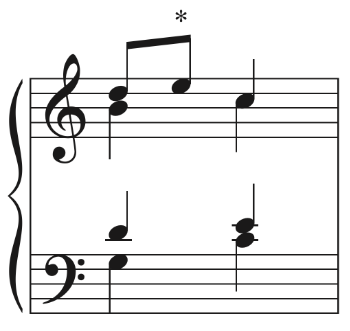
[0.1] This essay focuses on a figure of music that many would consider trifling: the escape tone. In current North American textbooks, it is usually described as a dissonance on an unaccented beat that is approached by step and left by leap, usually in the opposite direction. It is often illustrated with a change in harmony after the leap, as per Example 1. In textbooks and in classrooms, the escape tone is surely dispatched in short order, and it is probably not considered relevant to more advanced forms of analysis. However, I aim to show that its typical definition is inadequate, and to propose two more refined views that would have positive ramifications not only for undergraduate pedagogy but also for prolongational analysis. Further, I will show that one of the proposed redefinitions is not new, but existed in earlier theory textbooks before being discarded or overlooked by authors of more recent decades. This realization, in turn, will prompt a consideration of disciplinary “forgetting”: what the concept means, how it can occur, and why it might have happened in the present case.(1)
Example 1. Typical illustration of escape tone
(click to enlarge)
[0.2] In Part I, I survey the historical reception and evolving understanding of the escape tone. As I am interested in ways the figure has been taught, I restrict myself to textbooks of harmony and counterpoint. I further restrict myself to English-language, mostly American textbooks, because—as a theorist and teacher based in the U.S.—I already have access to a large corpus, which will enable a thorough review. In all, 136 books are indexed, spanning 1846–2020.(2) Early on, the escape tone matches what was called either a changing tone, often described as a neighboring tone that is left by leap, or a free anticipation, often described as an anticipation of a following chord member that is left by leap (i.e., an arpeggiation prefix). In the 1930s, escape tone or its French equivalent, échappée, began to be used, often with a definition in line with the prior changing tone. All three terms had currency for a while, but by the 1960s, escape tone/échappée became the norm. By the twenty-first century, the customary definition had evolved to that given in the opening paragraph. Though more precise in some ways, the earlier conception that an escape tone could be an arpeggiation prefix had fallen by the wayside. Though once common, over the decades this attribute was essentially “forgotten.”
[0.3] In Part II, I consider general theoretical attributes of the escape tone. I demonstrate that while the modern definition might seem superficially satisfactory, when compared to explanations of other non-chord tones, it is problematic because it defines the figure by shape rather than by function, it relates the dissonance to a prior event rather than to the goal, and it invites the acceptance of a “leaping resolution.” I investigate escape-tone possibilities, showing that the figure functions in one of two ways with respect to what follows. It is either an arpeggiation prefix, as observed in earlier textbooks; or it is part of a compound-melodic figure in which the dissonance implicitly resolves by step.
[0.4] In Part III, I focus on more advanced theoretical issues involving prolongational analysis. These stem from Part II’s deemphasis of the escape tone’s neighbor-suffix explanation in favor of its arpeggiation-prefix and compound-melodic functions. I compare foreground analyses of the same music—interpreting escape tones alternatively as upper-neighbor suffixes and arpeggiation prefixes—to consider which view is most consistent and contextually relevant. I progress to deeper-layer paradigms that include upper-neighbor suffix notation, and demonstrate their inherent ambiguity. I argue that neighbor suffixes function prolongationally only in highly circumscribed situations. For the most part, figures commonly described as such are better explained in other ways.
[0.5] In Part IV, I return to the idea that a past conception of the escape tone, as an arpeggiation prefix, was “forgotten” over the decades. To consider what it means for an academic discipline to “forget” earlier ideas, I turn to theories of organizational memory. To speculate about why the forgetting may have transpired in the present case, I consider two eras of music theory in the twentieth-century America, which coincide with the divide between the older and newer textbook definitions: the paradisciplinary era and the early disciplinary era. The explorations of this section are not only germane to the topic of the essay, they also serve as a cautionary tale about disciplinary pitfalls and highlight an underexplored facet of how disciplines evolve.
[0.6] In sum, I offer a disquisition on the escape tone that engages both its past and its future: the former by seeking answers to problematic current definitions in bygone explanations, and by speculating about the reason these explanations might have been forgotten; and the latter by thoroughly investigating the figure’s possibilities and proposing revised conceptions that can be useful in different types of analysis.(3)
I. History
Earlier English-language textbooks: Changing tones
[1.1] In English-language harmony and counterpoint textbooks from the late-nineteenth through the mid-twentieth centuries, the escape tone is found under two different names: the changing tone and the free anticipation.(4) I will commence with the former, my study of which is the result of examining eighty textbooks from 1846 to 1957 that use the term (see the Appendix for a list). The end of the 1950s was selected as the cutoff date because by the 1960s the terms “escape tone” and/or “échappée” were commonly used for our figure of focus. Note that almost all the texts originated in English, but six were translated from German, where the original-language term was Wechselnote.
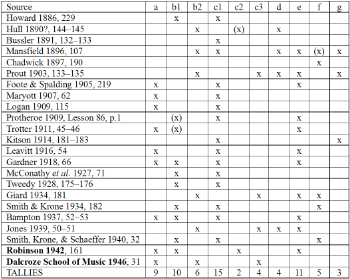
[1.2] The changing tone turns out to be a protean term with six different definitions.(5) In increasing order of usage, it can refer to an accented passing tone; a nota cambiata; an appoggiatura (accented neighbor prefix); a complete neighboring tone; an escape tone; and a double neighboring tone.(6) Nineteen of the texts (24%) apply the term in more than one way. Let us consider only the meaning that aligns with the escape tone. Example 2 lists twenty-three textbooks from 1886 to 1946 that use the term in this manner. Mansfield (1896) provides one of the more thorough definitions. He observes that the figure occurs “[w]hen two harmony notes
Example 2. Results of survey of twenty-three English-language textbooks (1886–1946) that use “changing tone” in a manner consistent with an escape tone
(click to enlarge)
[1.3] Mansfield’s description implicitly requires a change in harmony after the changing tone (he refers to two harmony notes descending by a second, which suggests there are two different chords).(7) The same is true of seven other texts (some of which are more explicit about the change): Bussler 1891, Chadwick 1897, Prout 1903, Foote and Spalding 1905, Smith and Krone 1934, Jones 1939, and Robinson 1942.(8) Even if a given definition does not indicate a change in harmony, all musical illustrations show one, excepting a non-harmonized melody in McConathy et al. 1927, 71.
[1.4] If we examine all the sources, we can compile a thorough picture of the changing tone as escape tone. We learn that: it is an unaccented note; it is approached as an upper or lower neighbor (but more commonly an upper neighbor); it is left by skip (perhaps in the direction opposite to the neighboring motion, and more commonly by descending skip); it usually embellishes the descent of a second, and skips by third to the goal; and it may anticipate a note of the goal harmony. However, this information is given in scattered fashion, as conveyed by the alphanumeric symbols of the table. By far the most asserted characteristic is that the note is left by leap (in some manner); all sources but Chadwick 1897 make this claim (though in the case of Hull 1890? it is only implicit).(9) About two-thirds (i.e., sixteen) of the entries also indicate (at least implicitly) that it is a neighboring tone of some kind.(10) None of the other cited characteristics cross even the fifty-percent threshold. Thus, the consensus view, such that one exists, is that the escape tone variant of the changing tone is a neighboring tone that is left by leap.
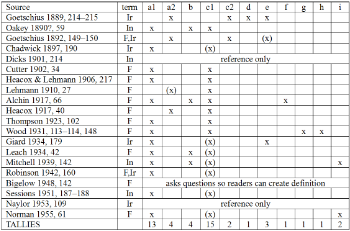
Earlier English-language textbooks: Free anticipations[1.5] As noted, some of the prior textbooks point out that the escape tone (as we call it) anticipates a note of the goal harmony. Specifically, four texts do so: Chadwick 1897; Girard 1934; Smith and Krone 1934; and Smith, Krone, and Schaeffer 1940. This observation is related to the second term from this period that encompasses the escape tone: the free anticipation, less commonly called the irregular or indirect anticipation. Example 3 lists twenty sources from 1889 to 1955 that refer to this kind of anticipation. The end of the 1950s was selected as the cutoff date for the same reason as before.
Example 3. Results of survey of twenty English-language textbooks (1889–1955) that use “free,” “irregular,” or “indirect anticipation”
(click to enlarge)
[1.6] Goetschius (1889) provides a fairly detailed definition of the escape tone: it is an anticipation that, instead of “remaining upon the note
[1.7] By the nature of the term, all free anticipations do two things: they anticipate a note of the following chord, and they are left by skip (which is what makes them “free”). In short, they are arpeggiation prefixes. Several of the texts indicate only these facts, and nothing else. Indeed, sometimes a text does not even explicitly state that the anticipation is left by skip; it is implied by stating that the anticipation is not repeated but moves to another member of the same chord.(12) Nonetheless, if we survey all the sources, we can compile a thorough picture of the free anticipation. We learn that: it is an unaccented note; it may be approached as a neighbor (i.e., by step); it is left by skip (usually descending); it anticipates a note in the following chord; it is usually in the top melodic voice; it is usually shorter than the goal tone; it may be compared to certain embellished resolutions of suspensions; and it is common at cadences. As with the more granular details of changing tones, the preceding definitions are given piecemeal, as per the alphanumeric symbols of the table. In fact, almost all of the characteristics beyond the principal two are cited in just one or two of the sources.
Earlier English-language textbooks: The escape tone/échappée
[1.8] Now let us turn to English-language textbooks that explicitly use escape tone or échappée. Except for two sources from around 1900 (to be discussed under [1.19–1.20]), neither term appeared until the early 1930s, when échappée was employed separately by two authors who had studied in Paris with Nadia Boulanger: Walter Piston and Melville Smith.(13) Piston is of course the much better known of the two, as a noted composer, author of texts on harmony, counterpoint, and orchestration, and teacher at Harvard (1926–60). Smith, “an organist, teacher, and all-around musician” (DeVoto 2000, 265) taught at the Eastman School of Music (1925–30), Western Reserve University (1931–40), and the Longy School of Music (1941–62). Both musicians graduated from Harvard and then received travel grants to study in Paris: Smith from 1920 to 1924, and Piston from 1924 to 1926. Piston used the term échappée in Principles of Harmonic Analysis (1933), and Smith (with co-author Max Krone) used it in Fundamentals of Musicianship, Book I (1934). Presumably both learned it while in France.
[1.9] In Piston’s book, the échappée is first introduced as an embellishment that can occur between a suspension and its resolution, as shown in Example 4.(14) Here the échappée (A) appears as an upper neighbor suffix to the suspension tone (G); it skips downward by third, within the current harmony, to the resolution note ( Example 4. Piston’s illustration of an échappée embellishing a suspension (1933, 33) (click to enlarge)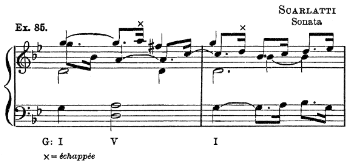
[1.10] Smith seems to have introduced the figure during his time at Eastman, where he began teaching the year after returning from Paris. It is included—under the name “escaped tone”—among the non-chord tones in a 1933 “Outline Syllabus of Harmony” for the school’s first-year theory classes.(16) The next year, in Smith and Krone’s book, the échappée is primarily addressed under the name changing tone. In a footnote, they clarify that it “is often an anticipation of some tone of the chord about to follow” (1934, 182, n.1). They add that, in many cases, it also “seems like an auxiliary [i.e., neighboring] tone which fails to return to the original chord tone. It may then be called an interrupted neighboring tone” (182, n.1). They provide the illustration of Example 5, which shows a complete neighbor figure and its abridgement. They explain that “[t]he French name echappé [sic] (escaped note) might well be used for this type of” non-chord tone (182, n.1).
Example 5. Smith and Krone&rsquo0;s illustration of an échappée as an “interrupted neighboring tone” (1934, 182, n.1) NB: labels “e” and “b” refer to changing and neighboring tones (respectively), as keyed to explanatory list
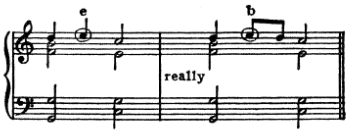
(click to enlarge)
[1.11] In the early 1940s, the escape tone/échappée nomenclature received a boost from inclusion in two signal publications: Piston’s Harmony (1941), which became the dominant textbook of the succeeding years,(17) and the first edition of the Harvard Dictionary of Music (1944), which became widely consulted.(18) Piston once again introduces the figure through the suspension. He adds, however, that it could be “applied to any basic melodic progression of a second, up or down” (1941, 112). Along these lines, he later shows how the authentic cadence can be embellished by an échappée, by interpolating between and , above V–I, resulting in what he labels a “V7(13)” chord (249). In the Harvard Dictionary, the term is found under the entries for “nonharmonic tones” and “harmonic analysis.”(19) The former entry acknowledges that its “classification and terminology” is based on Piston’s 1941 book (1944, 493), though in the present case it is actually more specific.(20) The échappée is described as being “rhythmically weak” and capable of occurring between “any larger interval, in descending as well as ascending motion,” as long as “the motion to the ornamenting tone is contrary to the motion to the harmonic tone” (1944, 492). In a musical illustration, an upper neighbor suffix is left by descending third (492, ex. 3). Neither book explicitly refers to the échappée as neighboring the initial tone (though their examples show it), and this despite the fact that Piston in 1933 referred to the figure as “leav[ing] a note by step” (34) and Smith and Krone in 1934 referred to its association with the “interrupted neighboring tone” (182). In short, these widely consulted books describe the figure in ways that omit details I would consider key.
[1.12] A few years later, Piston revisited the figure in his textbook Counterpoint (1947). The same year, Allen McHose included it in his textbook, The Contrapuntal Harmonic Technique of the 18th Century, which became popular in the ensuing years. In the 1950s and ’60s an increasing number of textbooks incorporated the term(s), and by the end of this period we can consider the escape tone/échappée nomenclature to have become standard. Example 6 lists thirty textbooks from the 1930s through the 1960s that use the terms; alphanumeric symbols indicate the definitions given. All sources indicate that it is approached by step (in one direction or another) and left by (some kind of) leap, although on rare occasion one of these characteristics may be implied.(21) Otherwise, no other attributes are cited in a majority of the cases, although nearly half of the sources note that it is common for the leap to be by third, and that the tone itself is unaccented.
Example 6. Results of survey of thirty English-language textbooks 1930s–1960s that use &ldquoescape tone” or &ldquoéchappée””
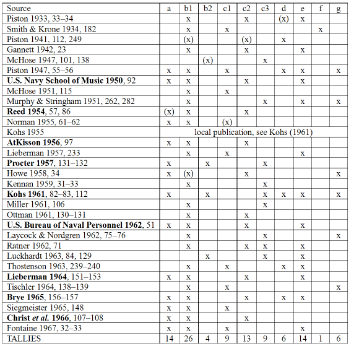
(click to enlarge)
[1.13] The vast majority of these texts are consistent with those previously surveyed, in that they present the escape tone such that there is a change in harmony after the leap. Two sources make this attribute part of their definition;(22) most of the rest suggest as much with their musical examples. Piston 1933 deviates by showing the previously reproduced Example 4, in which the resolution of a suspension is embellished; but even here an arpeggiation prefix is maintained, as noted above.(23) Conversely, three texts define the escape tone such that it can be a non-chord tone between two chord tones with unchanging harmony: Kennan 1959, Kohs 1961, and Laycock and Nordgren 1962.(24) Similarly, two texts employ unchanging harmony within author-composed illustrations: Reed 1954 and Tischler 1964.(25) In these cases, the escape tone cannot be an arpeggiation prefix. I will return to the implications of a single-harmony figure later.
[1.14] Of the échappée sources that illustrate a change of harmony, only one observes that the tone anticipates a member of the goal harmony: the aforementioned Smith & Krone (1934). Otherwise, this characteristic seems to have fallen by the wayside. Interestingly, this was not the case when the échappée was first discussed in French texts of the nineteenth century. Accordingly, this is an opportune time to investigate the original French view.
Excursus: The nineteenth-century French view of échappées
[1.15] We will start with an 1830 treatise by Daniel Jelensperger: L’Harmonie au commencement du 19me siècle et méthode pour l’étudier (Harmony at the Beginning of the 19th Century and a Method for Its Study; see 105–14, esp. 114). Jelensperger taught at the Conservatoire de Paris, where earlier he had studied with Anton Reicha. Although I am not aware of Reicha using “échappée” in print, according to his student Hippolyte Colet, he did employ the term (Colet 1837, 135, n.2.); so Jelensperger may have adopted it from him. In referring to neighboring tones, he considers three formulations: (1) one in which the chord tone occurs both first and last, and in between are one or two neighboring tones, i.e., our complete and double neighboring figures; (2) one in which the initial chord tone is omitted so that the succession consists of a neighboring tone and then chord tone, with the former called an appoggiatura; and (3) one in which the final chord tone is omitted so that the succession is chord tone then neighboring tone, with the latter called an échappée. Jelensperger’s échappée is thus an incomplete neighbor suffix. He notes that it is often a member of the following chord, such that there is a displacement between note and chord.
[1.16] Three decades later, in 1862, an explanation was provided by Henri Reber in Traité d’Harmonie (Treatise on Harmony; see 193–95). Reber also taught at the Conservatoire and had studied with Reicha. He describes the échappée as a neighbor note in which the return to the chord tone has been omitted, that is, “the échappée is a truncated neighbor” (l’échappée est une broderie tronquée). More significantly, in terms of its relation to what follows, the échappée may be a member of the subsequent chord and thus serve as an “indirect anticipation” (anticipation indirecte). Reber also asserts that the échappée is suited for principal melodies, not accompanimental parts, and that it is characteristic for the échappée to be above the preceding chord tone (i.e., to be an upper neighbor) and to skip to a note below it.
[1.17] Two decades after Reber, there is the definition provided by Émile Durand in Traité complet d’harmonie théorique et pratique (Complete Treatise on Theoretical and Practical Harmony, 1881, 495–97). Although Durand did not study with Reicha like Jelensperger and Reber did (he was only six when Reicha died), he too attended, and later taught at, the Conservatoire. Like Jelensperger, Durand adopts the three-fold category of neighboring figures: the complete neighbor, the prefix appoggiatura, and the suffix échappée. He observes that the échappée should occur not only on a weak beat but, better still, a weaker portion of that beat. He also declares that échappées can be applied to passing or ornamental notes as well as to chordal notes. Like Reber, Durand describes the échappée as “often only an indirect anticipation” (souvent qu’une anticipation indirecte).
[1.18] The common themes of the French texts are that the échappée is an abridged neighboring figure that is (implicitly) left by skip, and that often anticipates a tone in the following chord. Additionally we learn that it is unaccented; typically an upper neighbor that leaps downward; best reserved for the principal melody; and applicable to both embellishing and chord tones.
[1.19] As a point of contact with the English-speaking world, we will end with Albert Lavignac and his La musique et les musiciens (Music and Musicians, 1896, 306–8). Like the preceding writers, Lavignac had been first a pupil then a teacher at the Conservatoire de Paris. He too describes the échappée as a “truncated neighboring figure” (broderie tronquée) and notes that it is often an “indirect anticipation” (anticipation indirecte). He adds nothing new to the definition, but his explanation is significant because the book in which it occurs is the only one of the cited French texts to be translated into English, and just three years later (1899, 263–64). Accordingly, Lavingac’s definition of échappée seems to have been the first to appear with that name in an English-language text.
[1.20] Lavignac’s definition was further circulated when it was partially imported into Ralph Dunstan’s A Cyclopaedic Dictionary of Music (1908, 124). Dunstan describes the échappée as “[a] ‘hanging’ or ‘anticipatory’ note.” Both terms are given their own, separate entries. A hanging tone is defined in a manner consistent with what we would call a neighbor suffix (180). He adds that it “is often in the nature of an anticipation.” Under anticipation, he explains that the note may be octave displaced in the goal chord (27)—that is, to use our prior terminology, it may be a free anticipation. In the échappée entry, he then quotes from the English translation of Lavignac: “If from a broderie [neighboring figure] the return-note, the repetition of the original note, is taken away, what remains is the échappée” (124). Dunstan provides a melody-only example to show just such a curtailment. From the two referenced terms and the Lavignac quotation, a reader could piece together a view of the échappée that resonates with the main points of the French texts: it is an incomplete neighbor suffix that is also an arpeggiation prefix.
The contemporary view
[1.21] We will conclude our survey by considering how the escape tone is presented in contemporary North American textbooks. Not all textbooks refer to the figure, but Example 7 indexes fifteen that do.(26) In terms of nomenclature, escape tone is always used, with incomplete neighbor (suffix) added sporadically and échappée used infrequently.(27) As shown in Example 8, the ubiquitous definition is that it is a non-chord tone approached by step and left by leap. Typically, it is added that the leap is (usually) in the opposite direction, and that the note (usually) occurs on a weak or unaccented beat (or a weak part of a beat). I will combine these into what I call the standard twenty-first-century American definition: the escape tone is a non-chord tone on an unaccented beat (or part of a beat) that is approached by step and left by leap in (usually) the opposite direction. None of the definitions mention whether or not there is a change in harmony after the leap, although the musical examples almost always show one.(28)
Example 7. Results of survey of fifteen recent English-language textbooks that refer to “escape tones”: Nomenclature
(click to enlarge) | Example 8. Example 8. Results of survey of fifteen recent English-language textbooks that refer to “escape tones”: Definitions
(click to enlarge) |
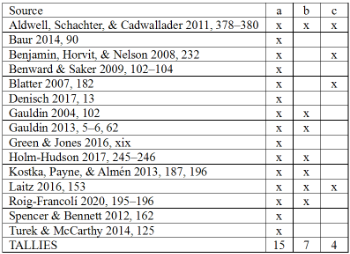
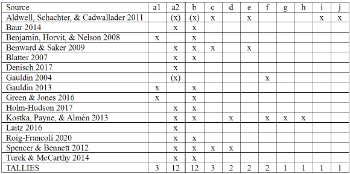
[1.22] Refinements are occasionally made to this definition, just as supplemental definitions existed in the earlier corpuses. These are also identified in Example 8. Those that occur in more than one source explain that the escape tone usually consists of a step up followed by a leap down by third; occurs most frequently in the soprano (or uppermost) voice; may have (or usually has) a length shorter than a beat; and is encountered within cadential gestures, such as above V in V–I. Rarer explanations mention that the escape tone may sequentially embellish a descending line, and that it is usually diatonic. One source explicitly affirms that the escape tone leaps to a chord tone (Laitz 2016, 153), but that detail may be taken as implicit in other definitions, which generally focus on non-chord tones within surrounding chord tones. These supplemental explanations are helpful, but like the ones encountered in prior surveys, they are dispersed and not the norm.
Summary of definitions
[1.23] I will now step back and summarize what we have found. In English-language textbooks from the 1880s through the 1960s, the escape tone is addressed in three ways. As both a changing tone and an escape tone/échappée, the consensus view is that it is a neighboring tone (of some kind) that is left by leap (in some manner). As a free anticipation, the consensus view is that it is an anticipation of a following chord member (either literally or by implication) that is left by leap. Hovering outside of this tradition, but tethered to it by the origins of the term échappée, is the earlier French idea that it is an incomplete neighbor suffix that often anticipates a tone in the following chord. At present, the standard American definition is that the escape tone is a non-chord tone on an unaccented beat (or part of a beat) that is approached by step and left by leap in (usually) the opposite direction.
[1.24] The changes over time can be evaluated from two perspectives. If we take a presentist view, then the escape-tone definition has become (slightly) more detailed and refined over the years. Of the twenty sources from 1889 to 1955 that address the free anticipation, none include all elements of our standard definition.(29) Of the twenty-three sources from 1886 to 1946 whose changing tone corresponds to an escape tone, two (9%) include all elements (as marked by asterisks in the table), and they are from the end of the survey.(30) Of the escape-tone sources from 1933 to 1966, the number increases to nine of thirty (30%).
[1.25] On the other hand, if we consider the spectrum of evolving meanings without idealizing that of the present, we become aware that something has been forgotten: the idea of the chord-tone anticipation or arpeggiation prefix. It was fundamental to the free anticipation (and French échappée) definitions; it also occurred—occasionally—among the changing tone and earlier (English) escape-tone definitions. Mansfield (1896) has already been mentioned in this regard. Chadwick also asserts that “irregular anticipations” are “sometimes called changing tones” (1897, 190); and Giard gives examples of changing tones that are “irregular anticipations” of the subsequent chord (1934, 181). Smith and Krone are especially emphatic that “the changing tone is often an anticipation of some tone of the chord about to follow” (1934, 182, n.1); and this idea carries forth to Smith, Krone, and Schaeffer (1940, 32). Furthermore, of the free anticipation texts, four are yoked even more closely to escape tones by virtue of advocating a stepwise approach to the anticipatory tone: Oakey 1890?, Alchin 1917, Leach 1934, and Mitchell 1939. Oakey, for example, says that the figure “anticipat[es] a tone of the following chord,” is approached by step, then “leaps by a third” to the next note (59).
[1.26] For reasons to be discussed in the next section, I wish to recover the escape tone’s seemingly forgotten role as an arpeggiation prefix. This will not account for all figures presently called escape tones, thus another category will also be defined. The advantage of the proposed redefinitions is that they are more accurate in terms of function than the present American definition.
II. General Theory
Shape vs. function
[2.1] A problem with the present American definition is that it describes the escape tone figure in terms of its general shape, not the goal-directed function of its individual notes. To illustrate why this is problematic, let us turn for comparison to the nota cambiata of Fux’s third species; see Example 9a. Functionally we can describe the four notes as follows: note #1 is the point of consonant departure; note #4 is the lower point of consonant arrival; note #2 commences (indirect) dissonant passing motion toward note #4; and note #3 embellishes note #4 with a consonant neighbor prefix, on the opposite side of note #2. Once we leave note #1, the function of each note is defined by how it progresses toward the goal, note #4. Given this description, the only (primarily) descending form of the figure possible is that shown in Example 9a.(31) If we shift the figure one step higher vis-à-vis the bass, as shown in Example 9b, we retain the shape, but the functions are entirely lost. Example 9a is a nota cambiata; Example 9b is not (and depending on the broader context might even be impermissible counterpoint).(32)
Example 9. Nota cambiata figure (a) functional (b) shape only
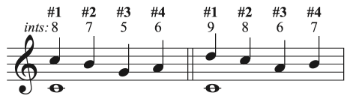
(click to enlarge)
[2.2] When we try to describe an escape tone figure by prospective function, as opposed to by shape, the typical explanation fails to define each note in terms of how it relates to the goal. Consider the instance shown in Example 10a, which follows the vast majority of textbooks in having a change in harmony after the leap. (I will address a single-harmony instance later.) Note #1 is the point of consonant departure and note #3 is the lower point of consonant arrival. What is note #2? It is higher than note #1 and is approached by step, so customarily it is called an upper neighbor suffix. But that term relates it “backwards” to note #1; it says nothing about how it relates to the goal. In contrast, let us consider the escape tone’s mirror-image twin, the appoggiatura, which is “approached by leap and left by step.” See the instance shown in Example 10b. Note #1 is the point of consonant departure and note #3 is the higher point of consonant arrival. Note #2 is typically explained as a dissonant upper neighbor prefix to note #3; that is its function in terms of how it progresses toward the goal. Thus, we can describe the constituent members of the appoggiatura figure in terms of their goal-directed functions, as we could for the nota cambiata; but we cannot do so for the escape-tone figure if we adhere to the customary anterior descriptor, “upper neighbor suffix.”
Example 10. Escape tone and appoggiatura figures (a) escape tone (b) appoggiatura
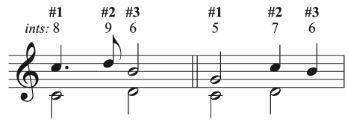
(click to enlarge)
Leaping resolutions?
[2.3] Another problem with the current American definition has to do with its (implicit) notion of resolution.(33) With the appoggiatura, we can truly say that the dissonance resolves. However, we cannot say the same thing about the dissonance of the escape tone—at least not in the same way. In tonal music, intervallic resolution occurs when a dissonant tone moves to a consonant tone, or when the context about a dissonant tone changes such that it becomes consonant (as with anticipations). More specifically, for the tonal energy of a dissonant tone to discharge upon its resolution, the motion must be stepwise. (Regular anticipations embody no motion and are special circumstances: the dissonance does not resolve to a consonance, it is recontextualized as a consonance.)
[2.4] The idea of a “leaping resolution” is not endorsed in any context except the escape tone. And even here it can be misleading. Consider Example 11. Which tone is the dissonance, and how does it resolve? Clearly the dissonance is the initial high F, which is the seventh of V7. It resolves by step to E, which is the third of I. The submetrical G is an escape tone, but it is not what resolves to E. What, then, is the function of G? Following the guidance of earlier textbooks, it belongs to the subsequent chord and thus is an arpeggiation prefix. In this case, the escape tone itself is consonant. But in prior Example 10a, the same function applies to note #2, the locally dissonant D. To return to a functional description of its three notes: note #1 is the point of consonant departure; note #3 is the lower point of consonant arrival; and note #2 is an anticipatory note that belongs to the chord of note #3. The stepwise relationship between note #2 and note #1 is secondary; the primary relationship of note #2 is to the chord of note #3. It is fundamentally an arpeggiation prefix (thinking prospectively), not a neighbor suffix (thinking retrospectively). To illustrate the point another way: functionally, the relationships shown in Example 12a are the same as those shown in Example 12b, despite the performative differences: notes #1 and #3 are structural; note #2 is an embellishment of note #3 and fundamentally belongs with it.
Example 11. Escape tone and dissonance resolution
(click to enlarge) | Example 12. Functional (not performative) equivalence of escape tone and grace-note arpeggiation (a) (b)
(click to enlarge) |
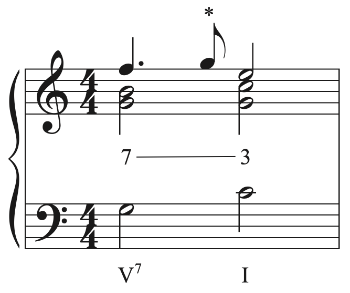
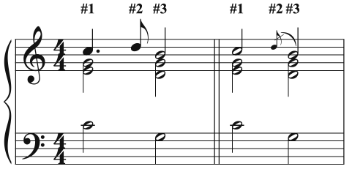
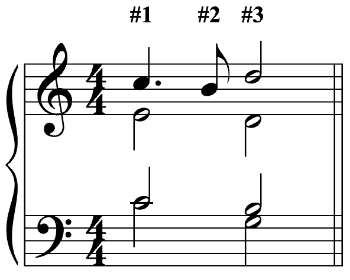
[2.5] The escape tones illustrated above have an overall descent (between notes #1 and #3), which is the most common contour. However, the same relationships are maintained when the contour is reversed, as in Example 13. Note #1 is the point of consonant departure; note #3 is the higher point of consonant arrival; and note #2 is again an arpeggiation prefix to note #3 (and its chord). Indeed, many years ago Allen Forte and Steven Gilbert (1982a) observed that “[i]ncomplete lower neighbor suffixes
Example 13. Escape tone in inverse contour
(click to enlarge)
Possibilities
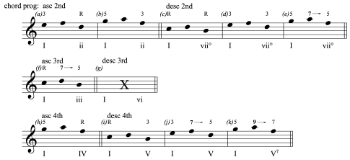
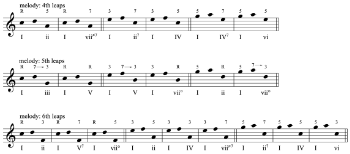
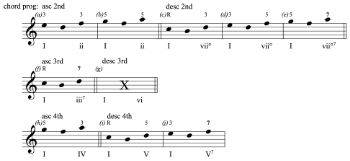
[2.6] I will now investigate all possible diatonic escape tones, starting with Example 14, which shows those of the most common configuration: ascending a step then falling a third, such that the dissonance is an arpeggiation prefix. Examples are shown in the key of C, but the progressions and chord memberships are generalizable; they can be shifted diatonically to any starting chord in any key. For example, 14c can represent any descending-second chord progression in which the first and third melodic notes are chordal roots. (Roman numerals are not intended to suggest any particular inversion, thus one should not infer forbidden parallels between the melody and an imagined bass.) Example 15 shows the set of escape tones if the contour is reversed, such that a descending step is followed by an ascending third, and the dissonance is an arpeggiation prefix. To complete the inventory, Examples 16 and 17 show the same basic contours as Examples 14 and 15, but the ending arpeggiation is a fourth, fifth, or sixth rather than a third. Example 17 has two fewer possibilities than Example 16 because the chord must change; thus the melodic successions C–B–E and C–B–G are disallowed when the chord would be I7 throughout.
Example 14. Escape tones as arpeggiation prefixes: up step, down third Chord membership identified as: R (root), 3 (third), 5 (fifth), etc. 7→ indicates anticipatory 7th (of following chord) NB: Roman numerals are not intended to suggest any particular inversion
(click to enlarge) Example 16. Escape tones as arpeggiation prefixes: up step; down fourth, fifth, or sixth 7→ indicates anticipatory 7th (of following chord) NB: Roman numerals are not intended to suggest any particular inversion
(click to enlarge) | Example 15. Escape tones as arpeggiation prefixes: down step, up third Chord membership identified as: R (root), 3 (third), 5 (fifth), etc. NB: Roman numerals are not intended to suggest any particular inversion
(click to enlarge) Example 17. Escape tones as arpeggiation prefixes: down step; up fourth, fifth, or sixth 7→ indicates anticipatory 7th (of following chord) NB: Roman numerals are not intended to suggest any particular inversion
(click to enlarge) |
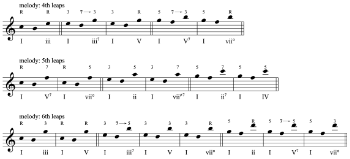
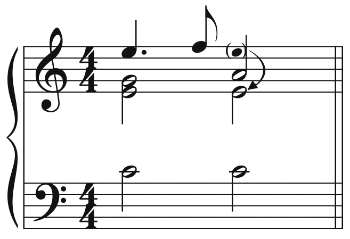
[2.7] Compared to the content of Examples 14–17, a smaller number of specimens have contours that are similar but functions that are different, as illustrated in Examples 18 and 19. Here the leap is still to a chord tone, but it is no longer from an anticipatory member of the goal chord. These are not arpeggiation prefixes. Instead, they are compound-melodic figures in which the initial two (stepwise related) notes belong to one strand of voice leading, and the third note belongs to another strand. As happens in compound melodies, when one strand takes over from another, the initial strand continues implicitly. The implied notes are given in parentheses.(34) They occur elsewhere in the chord; that is, they have been octave-displaced from the stepwise continuation we might have expected. This is illustrated explicitly in Example 20. Once the implied note is understood, the middle tone (the erstwhile escape tone) functions as part of complete neighboring motion. In other examples, it might form passing motion, or in one instance it is a consonant anticipation. Whatever the case, a conventional stepwise resolution is implied. If we desire a pithy label for this specimen (as per “arpeggiation prefix”), perhaps “bilinear leap” will suffice, as the figure consists of two voice-leading strands traversed by leap.
[2.8] We might also perceive the arpeggiation prefixes shown in Examples 16 and 17—those that end with arpeggiations of a fourth, fifth, or sixth—as compound-melodic. The difference is that there the arpeggiation aspect of the escape tone is primary. That is, the arpeggiation is always present as a unifying device, across Examples 14–17. In the case of Examples 18 and 19, there is no arpeggiation and thus the implicit continuation of the compound-melodic line becomes paramount.
Example 20. Implied resolution of escape tone, octave displaced from literal appearance
(click to enlarge)
Example 18. Escape tones as bilinear leaps: up then down contour NB: Roman numerals are not intended to suggest any particular inversion
(click to enlarge) | Example 19. Escape tones as bilinear leaps: down then up contour NB: Roman numerals are not intended to suggest any particular inversion
(click to enlarge) |
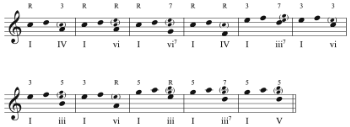
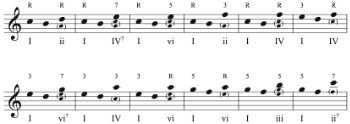
[2.9] In terms of pedagogy, arpeggiation prefixes can probably be introduced earlier in an undergraduate class than bilinear leaps, as arpeggiations are a more basic concept than compound melodies and implied tones. But whatever their placement in the course sequence, the key realization is that not all figures traditionally labeled “escape tones” function in the same manner, and goal-directed function (not shape) should be clarified when defining non-chord tones. The arpeggiation prefix is an apt label for a frequent type of what has traditionally been called an escape tone. A smaller set of figures usually called escape tones may be called bilinear leaps. I recommend clarifying the nebulous label “escape tone” with these more precise designations. Depending on how restrictive we wish to be, we could advise students that the figures either are typically, or must be, approached by step and left by leap in the opposite direction. (In the case of the bilinear leap, the use of “linear” perhaps presupposes an approach by step.) If we say they “are typically” (i.e., they are not necessarily) approached by step and left by leap in the opposite direction, then some figures not now recognized as escape tones could creep in. For example, the step and the leap might be in the same direction, or the initial approach of an arpeggiation prefix might be by leap. Even so, we would be more accurate in our functional description while allowing for creative variants we might encounter in the musical literature.
[2.10] To conclude Part II, I will briefly address three remaining issues: the presence of sevenths and ninths within arpeggiation prefixes, leaps both from and to a dissonance, and escape tones when there is no change in harmony.
Prefix sevenths and ninths
[2.11] In the descending arpeggiation prefixes of Examples 14 and 15, the prefix tone is sometimes a chordal seventh; but it may be a prefix to what is given as a simple triad. That is, the chordal seventh may not (re)appear in the goal harmony, as it would in a literal indirect anticipation; see Example 21. This possibility was recognized in the earlier Goetschius (1889) quotation, which noted of the indirect anticipation that it “appears in some other [voice]; or it is understood,” for example as a “possible [s]eventh” (214, italics added). I would add that the seventh may or may not continue its effect, implicitly, during the goal harmony. When it does, we can imagine an octave-displaced seventh occurring elsewhere in the chord. When it does not, the chordal seventh prefix may be thought of more precisely as a non-functional, embellishing consonant skip‚ though for convenience I will retain the “arpeggiation prefix” label.(35)
Example 21. Seventh as arpeggiation prefix, not recurrent in goal chord
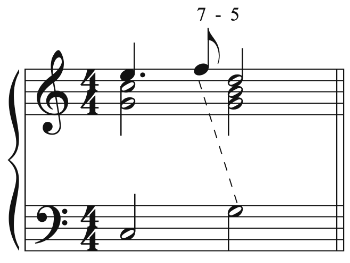
(click to enlarge)
[2.12] More problematic is a chordal ninth prefix, as identified by the “9” over fragment (k) in Example 14. Goetschius (1889) also raised the issue, by adding a parenthetical “or [n]inth?” to the possibility of an implied seventh (214). There are several reasons he might have been uncertain about the prospect. First, in traditional tonal practice, the ninth is typically limited to the dominant chord. Other ninths would not be as idiomatic, whereas our other figures can be diatonically transposed to any chords. Second, it may be more difficult to think of the ninth as continuing its effect in an octave-displaced form, as ninths are typically in the uppermost part. Third, the ninth prefix might be heard not as skipping to the seventh, but as returning implicitly to the note of departure (i.e., the root of the seventh chord). That is, the motion may be perceived as a complete neighboring figure. See Example 22, in which the lower note of the literal skip is interpreted as the lower strand of a compound melody. Fourth, it is frequently the case that a ninth is non-structural. Rather than serving as a true chordal ninth, it functions as an embellishing tone above the seventh; that is, it skips or passes to the seventh, which is the actual resolving tone.(36) Indeed, due to this last idiom, it is often best to consider a chordal ninth prefix to be a non-functional consonant skip that embellishes a seventh chord. But as before, for simplicity, I will maintain the “arpeggiation prefix” label.
Example 22. Ninth as arpeggiation prefix (cf. Ex. 14k), with 9–(8) neighboring implication
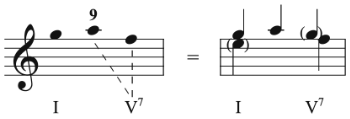
(click to enlarge)
Leaps from dissonances to dissonances
[2.13] As we learned previously, Piston (1933) allows the note preceding the escape tone to be not just a consonance but a dissonance “such as the suspension,” and the note after the escape tone to be “an appoggiatura or a cambiata” (34). We have already considered an escape tone before the resolution of a suspension (in relation to Example 4), where we found that it still functions as an arpeggiation prefix, albeit one that is locally consonant. But what of a leap from a dissonant escape tone to a dissonant appoggiatura (something not explicitly allowed in other texts)? As with Examples 18 and 19, they represent bilinear leaps. This is illustrated in Example 23. At (a), for instance, on the left side we see the two dissonances marked by asterisks. In the middle, we see the bilinear implications. On the right side we see an additional (though optional) interpretation: a rhythmically and contrapuntally normalized version, in which the escape tone and the (former) appoggiatura are now relocated to a weak upbeat. The other examples are similar, except at (c) the normalization is not possible due to parallel fifths. Note that the example at (d) skips a third—the smallest skip possible—between the two dissonances. The third may represent a threshold case for perceiving compound melodies: it certainly can be interpreted as such, but it could also be heard as a small leap within a single line. If the compound-melodic view does not seem compelling in this case, one could think of the escape tone (A) as relating to the appoggiatura (F) as a surface consonant skip, as with the ninth discussed above. That is, F embellishes E, and A embellishes F.
Example 23. Leaps from dissonant escape tones to dissonant appoggiaturas

(click to enlarge)
Escape tones without a change in harmony
[2.14] In our surveys of Part I, we observed that all texts that use “changing tone” in a manner consistent with an escape tone show a change in harmony after the leap, and several texts make that feature part of their definition. Also, all texts that use “free anticipation” in a manner consistent with an escape tone have, by definition, a change in harmony after the leap. It is only with the 1930s–1960s texts that explicitly use “escape tone” or “échappée” that we find occasional acceptance of the figure occurring within a single (non-changing) harmony. Even in twenty-first-century American texts, this occurrence is infrequently illustrated. Nonetheless, the figure might occur in this manner. In Example 24 we see illustrations in which an escape tone follows (successively) the fifth, root, and third of a chord, before leaping to the next-lowest member of the same chord. Here again the examples are compound-melodic and thus represent bilinear leaps. In the case of Example 24b, for instance, the note D is not related backwards to C, nor is it related forwards to G. It is an upper neighbor to a following implied C. The literal ending G is an “alto” voice that appears instead.
Example 24. Escape tones without a change in harmony [AB: Might we want a version of this figure with (a), (b), and (c) included in the png image? Formatting this with text is finnicky to get those labels exactly right. Otherwise, please clarify how you would like this to work and I can do what's needed on my end to make it happen.
n.b. example sizes from here on for this article are not finalized; those will be adjusted once I know how we want captions to look here.]
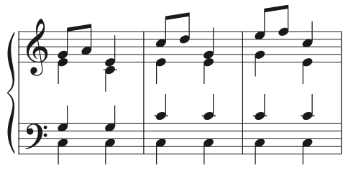
(click to enlarge)
III. Prolongational Issues
“Goes with” vs. “goes to”
[3.1] In Part II, I redefined the escape tone as either an arpeggiation prefix or a product of an implied compound melody. That is, I interpreted it in terms of what follows, not what came before, as would be the case with neighbor suffixes. This view has implications for prolongational analysis. To set the stage for our investigation, I will commence with advice given by Allen Forte and Steven Gilbert on how to employ slurs in prolongational notation. They write that slurs should “show that things go with other things, rather than to them” (1982b, 10).(37) To illustrate what this means, I will consider a brief excerpt from Mozart’s Die Zauberflöte (The Magic Flute), shown in Example 25. In the upper staff we find a melody that descends stepwise from G to
Example 25. Escape tones without a change in harmony[AB: Same comment as Ex 24] (a) (b) (c)
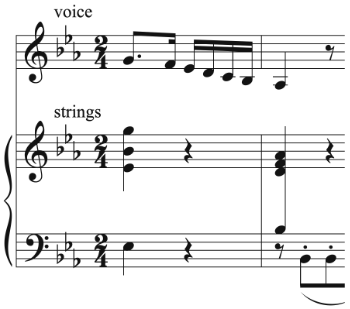
(click to enlarge)
[3.2] The “with” versus “to” guidelines intersect with escape-tone interpretations, as shown in Example 26. At (a), there is a descending melodic line embellished with escape tones. Logically, the escape tones must be interpreted in one of two ways: either as upper neighbor suffixes, as at (b), or as arpeggiation prefixes, as at (c). Without contrapuntal or harmonic support, one might hold that a decision cannot be made. But I would argue that the forward flow of music suggests that the second interpretation is generally better, as it shows the escape tones as consonant skips that “go with” the subsequent accented notes, whereas the first interpretation merely shows that each accented note “goes to” a note a step above. This view becomes clearer when we consider a similar line that has been given harmonic support: an excerpt from a Mozart piano sonata; see Example 27a. If we prioritize the “goings to” of stepwise motion, then we derive the analysis of (b), in which the melodic line has upper-neighbor suffixes and the bass line has lower-neighbor prefixes. But this analysis is flawed in that the embellishments of each line are being considered apart from the other line’s context. As a result, vertical events are not shown as “going with” one another.(38) For example, the A5 in m. 1 is interpreted as a neighbor to a prior note, while the simultaneous
Example 26. Interpretations of embellished descending line[AB: Same comment as Ex 24] (a) (b) (c)
(click to enlarge) | Example 27. Mozart, Piano Sonata in C Major, K. 309: I (a) score, mm. 3–5 (b) interpretation #1 (c) interpretation #2 (preferred)[AB: Same comment as Ex 24]
(click to enlarge) |

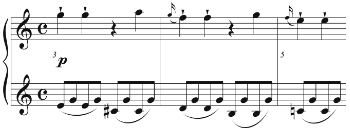
[3.3] In sum, the analyses of Examples 26b and 27b arise only if we prioritize stepwise “goings to” over more contextually relevant, if skipping, “goings with.” In these particular instances, the problem also arises if we adhere to the customary notion of escape tones as backwards-relating neighbor suffixes instead of goal-directed arpeggiation prefixes.
Prolongation at deeper layers
[3.4] Similar interpretations can affect deeper layers of prolongational analysis. To set the stage for our discussion, I will first consider what Heinrich Schenker (1979) called substitution. It occurs when the voice leading and contrapuntal/harmonic context clearly imply the presence of one note, but another note occurs in its place.(39) Substitutions are most palpable when they occur within what should be stepwise lines (that is, if all members are present). When the melodic trajectory is clearly directed toward a goal in a way that suggests stepwise continuity, but a member of the stepwise line has been replaced by another note (belonging to the same chord as the omitted note), we perceive the effect and implication of the missing note. Accordingly, substitutions are often associated with the Urlinie and its lower-layer replicas.
[3.5] The relevance of substitutions to upper-neighbor suffixes is as follows: If is the Kopfton, may be absent in the register of the Urlinie (or its replica), in which case may substitute. Example 28 shows two hypothetical contexts in which this might occur; see (a) and (b). In each case, when first appears, it has a stepwise connection to Kopfton , as its upper neighbor; but afterward the line continues to descend, ––. Because of the linear context, is thought to be standing in for . And because is a step removed from , the two notes are traditionally shown with a slur connecting them (such that is the deeper event).(40) There are, however, two problems with this interpretation. The most significant is with the context at (a), where melodic (A) is shown to be prolonging the prior (G), harmonized with the tonic, at the same time that bass (F) is shown to be prolonging the subsequent , harmonized with the dominant. How can there be two simultaneous prolongations, one of tonic and one of dominant? The context at (b) sidesteps the contradiction, in that its first three events all prolong the tonic. And yet there is still another problem (endemic to the prior context as well): how does melodic (A) implicitly resolve? Though literally leaps to , its energy discharges upon an implied (octave-displaced in the music), as in the implied neighboring events of Example 18. Accordingly, the analysis of Example 29 is preferable.
Example 28. Substitution of for (a) context #1 (b) context #2[AB: Same comment as Ex 24]
(click to enlarge) | Example 29. Preferred interpretation of Ex. 28a
(click to enlarge) |
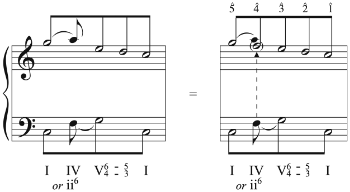
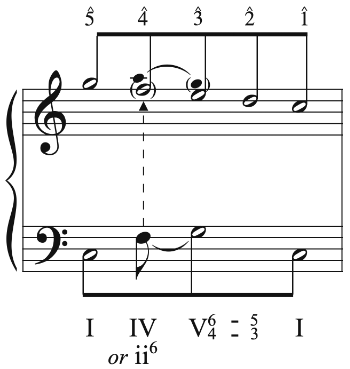
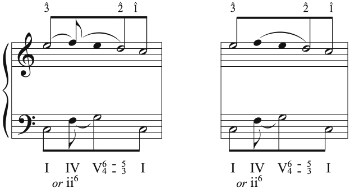
[3.6] Another situation involves a common cadential paradigm that can appear at various layers of structure including the deep middleground; see Example 30a, which provides a typical analytic notation.(41) A central problem with this notation is the ambiguous status of melodic (F). On one hand, it is clearly indicated as a neighboring tone to the prior , by both slur and flag. (Sometimes the slur is omitted, but the remaining flag still typically denotes a neighbor.)(42) On the other hand, is slurred forward to , indicating motion from the seventh to the fifth of V—a filled-in arpeggiation prefix. It appears as if is simultaneously prolonging both the prior and the subsequent —both the tonic and the dominant. In keeping with our earlier interpretation of escape tones as arpeggiation prefixes, I recommend eliminating both the slur connecting and and the flag on . The stepwise motion is simply a product of “going to.” The more fundamental “going with” is between and . Thus, the notation of Example 30b is preferable.
Example 30. Common cadential paradigm at deep middleground level (a) interpretation #1 (b) interpretation #2 (preferred)[AB: Same comment as Ex 24]
(click to enlarge)
[3.7] Some might argue that, in the prior examples, a better option would be to say that what initially sounds like an upper neighbor suffix is retrospectively reinterpreted as an arpeggiation prefix or bilinear leap. In other words, both claims are valid, but from different perspectives; accordingly, the Janus-faced slurring of Example 30a is apt. However, this is simply not the way that conventional prolongational analysis (and its notation) works. It requires that choices be made; it requires disambiguation. If two different interpretations remain viable after careful reflection, they can be represented on two separate (cross-referenced) analytic graphs. But to incorporate variant interpretations into the same voice-leading analyses would be to open a Pandora’s Box in which every stepwise line participates in multiple, overlapping linear progressions; every prefix to one event is also a suffix to another; and so forth. Slurs would proliferate to the point of being meaningless. Kofi Agawu once argued that musical ambiguities—i.e., “musical situation[s]
Are incomplete neighbor suffixes prolongational?
[3.8] I have reconsidered the escape tone in a manner that deemphasizes its neighbor-suffix aspect in favor of its arpeggiation-prefix or compound-melodic functions; and I have shown how this perspective may influence prolongational analysis. A broader question is thus raised: should incomplete neighbor suffixes be considered prolongational at all? Before I attempt an answer, some concepts must be defined. First, the fundamental types of melodic embellishment or elaboration—and thus prolongation—are passing motion, neighboring motion, arpeggiations (or consonant skips), and displacements (anticipations, suspensions, etc.). Second, given these devices, a tone or harmony may be prolonged by either a prefix or a suffix—that is, it may be prolonged by events either leading into it or leading from it. Passing motion gives rise to linear progressions, which may either culminate with the deeper tone (as would an initial ascent) or follow from it (as would a subordinate third-progression that prolongs an Urlinie tone). Likewise, arpeggiations across two or more chord tones may either lead to or from the deeper event. Displacements rhythmically relocate the deeper event to moments earlier or later. Complete neighboring motion is neither prefix nor suffix but rather a “running in place” figure: there is departure from and return to the same (prolonged) note, with the adjacent tone in between serving the embellishing role.
[3.9] What of incomplete neighboring motion? When it is a prefix—that is, when it leads to the deeper event—it is unproblematic due to the forward flow of music from dissonance to resolution, from an embellishing event to that which is being embellished. This is especially true where a surface dissonance is formed and immediately resolves, as with an appoggiatura (which is an incomplete neighbor prefix). But it is also true of slightly deeper embellishing prefixes that are transformed into surface consonances. Consider the common bass formula where , harmonized by ii6 or IV, prolongs the deeper and subsequent , harmonized by V. Once we hear in the bass, we strongly suspect that it may be directed toward the adjacent tonal anchor, . We anticipate ’s neighboring role—though of course we could be wrong, and it might behave differently. Such prefixes are among the musical events that Schenker called “signposts to the future” (Schenker 2001, I:240). They allow us to sense “in advance
[3.10] An incomplete neighbor suffix, however, would have to function quite differently. For such an event to exist, it would have to have the following two characteristics. First, it must not be contrapuntally displaced. If the event is dissonant but contrapuntally displaced, then at a deeper layer it “really” belongs in another vertical position, where it is consonant. Such is the case with the alleged neighbor suffixes that are actually arpeggiation prefixes (i.e., indirect anticipations). Once the counterpoint is normalized, they are neither suffixes nor dissonant.
[3.11] Second, it must not be related to what follows (only to its consonant antecedent). “To relate to what follows” means the event either continues to be prolonged or it resolves (which are the only two options). If it does either (even implicitly), then the event is not terminal and thus not a suffix. For example, we have seen that alleged neighbor suffixes often have an implicit resolution by step. If so, they are no longer incomplete neighbors; they are (implicitly) complete neighbors, or perhaps passing tones.
[3.12] If the dissonant event is not displaced and does not relate to what follows, then we have a true suffix situation; the event is terminal; it ends a prior prolongation, albeit in a non-resolved fashion. What does this mean, practically speaking? Musical parameters would have to conspire to suggest some sort of voice-leading caesura after the event. Schenker (1979) discusses two situations in which this happens. One is interruption. In the case of a –|| interruption, the may superficially resemble a lower neighbor suffix, but it is not one. –|| represents passing motion from to that has prematurely broken off (and that will be begun again and completed later on).(44) The other situation involves the applied divider, also called the back-relating dominant, in which the tonic is prolonged by a bass arpeggiation to its upper fifth (). The resulting V relates only to the tonic that precedes it; it does not have a connection to what follows. (Schenker refers colorfully to how there is a “bolting down” or “sealing off” of the voice leading.)(45) The applied divider serves as a kind of musical punctuation mark. And as I–V can support stepwise melodic motion, it may lead to neighboring events: –, ^1–, or –. Other neighboring possibilities arise from applied dividers at secondary levels (i.e., back-relating secondary dominants).
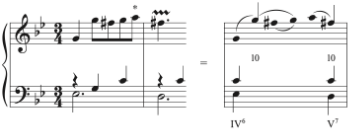
[3.13] In sum, interruptions may halt on dissonant events that simulate neighbor suffixes, and applied dividers may halt on actual neighbor suffixes. But apart from these contexts (which are highly circumscribed and already have names), it is questionable if a “neighbor suffix” could justifiably exist. Consider the alleged neighbor suffix (i.e., escape tone) in the Handel excerpt in Example 31a. There is no voice-leading caesura after the neighbor; the motion continues emphatically toward the dominant (D7). It is not a terminal suffix, it is an arpeggiation prefix, as interpreted in the voice-leading sketch at (b). Such would be the case with the vast majority of alleged neighbor suffixes. In almost all instances, they would be arpeggiation prefixes or bilinear leaps.
Example 31. Handel, Minuet in G Minor, HWV 434: IV, mm. 13–14 (a) score (b) voice-leading analysis[AB: Same comment as Ex 24]
(click to enlarge)
IV. On Forgetting (and Remembering Again)
[4.1] I began this essay by investigating past conceptions of what is today called the escape tone. I showed that a prominent element of an earlier definition—its function as an arpeggiation prefix—was seemingly forgotten over the decades. But what does it mean to say that an academic discipline “forgot” earlier knowledge? And how might that have happened in the present context? I will close by addressing these questions, as the answers are not only germane to the topic of this essay, they also touch on an underexplored facet of how disciplines evolve, while providing a cautionary tale about supplanting older ideas with newer ones.
[4.2] Because issues of (transnational) cultural transfer are complex,(46) I will exclude from this consideration the earlier French texts. Their direct impact on English-language reception seems negligible, and even as indirect sources we cannot know what Piston and Smith received from Boulanger nor the provenance of the latter’s understanding. The six texts translated from German may also be excluded, though the correspondences between changing note and Wechselnote arguably present no problems. The principal focus of the textbook surveys of Part I was on sources that were (originally) English-language and especially American, and it is to them I will restrict myself here.
Disciplinary memory and forgetting
[4.3] Organizations and institutions are often said to possess memory: organizational memory comprises the collective knowledge, information, and experiences accumulated within an organization over time. It can take tangible forms, such as documents, manuals, and databases; and intangible forms, as per employee expertise, institutional practices, and an awareness of the organization’s culture. This memory is variously stored, retrieved, and utilized to enable ongoing operations, decision making, and problem solving.(47) When applied to fields within the academic world, organizational memory may be called disciplinary memory, with related changes to its tangible forms, which would now include textbooks, scholarly articles and monographs, and so forth.(48)
[4.4] If organizations and disciplines can remember, they can also forget. Pablo Martin de Holan and Nelson Phillips describe “organizational forgetting as the loss, voluntary or otherwise, of organizational knowledge” (2004, 1606). The results might be either positive or negative, as clarified by the four types of organizational forgetting proposed by Vicenc Fernandez and Albert Sune, which are based on the intersection of “the codifiability of knowledge” (that is, its tangibility or intangibility) with “the intentionality of the forgetting process” (2009, 620).(49) To illustrate, let’s consider just two of the categories. The intentional forgetting of codified knowledge might take the form of eliminating “old procedure handbooks” and replacing them with new ones (627). This strategic act might lead to positive outcomes, as the new handbooks would presumably aim for increased efficiency and refer to the most recent technological tools. On the other hand, the unintentional forgetting of non-codified knowledge might stem from the resignation of an employee (628). This random act might lead to negative outcomes, as the organization would lose the individual’s expertise and institutional knowledge.
Two eras
[4.5] How did American music theory come to forget the older textbooks, whose “free anticipations” could include escape tones, and whose “changing tones” might anticipate a note of the goal harmony, while remembering their successors, which were focused on later definitions of escape tones/échappées and the idea of neighbor suffixes? Although any answer must rely on speculation, evidence accrues from the observation that the divide between the older and newer textbooks corresponds roughly to the divide between the paradisciplinary era of music theory and the early disciplinary era.(50)
[4.6] By the paradisciplinary era, I refer to a period in the first half of the twentieth century when American music theory was taught in colleges and universities, and the subject was treated in books, scholarly journals, and conference papers, but more as an adjunct to music pedagogy, musicology, and contemporary compositional theory than as an autonomous field. Several factors led to theory’s increasing relevance during this period. Its pedagogical forms became more prominent because “courses in harmony and related subjects continued to join the curricula of colleges and universities, where they had just begun to be welcomed in the late nineteenth century” (Berry 2013, 172).(51) There was an expansion in the status and activities of musicology, in a broad sense that included theoretical research. For example, “the American Council of Learned Societies established a committee on musicology in 1929, the New York Musicological Society was formed in 1931, and from it the American Musicological Society was created in 1934.” “[P]eriodicals arose that were receptive to theory-oriented articles. The proceedings of the Music Teachers’ National Association [MTNA], which resumed in 1906 after a hiatus, frequently included such material, as did Musical Quarterly (1915–present), Modern Music (1924–46),” Musicology (1945–49), and the Journal of the American Musicological Society (1948–present). And finally, conferences emerged where theoretical research could be shared and discussed. The annual meeting of the MTNA provided an early resource, and from the 1930s onward there was the American Musicological Society and its various regional chapters.
[4.7] The end of the paradisciplinary era segued into the early disciplinary era, by which I mean the period in which American music theory first began to be accepted in academia as a research field. Generally speaking, this period began to coalesce in the 1950s and early ’60s, with what Milton Babbitt later called the first generation of “professional theorists” (1987, 121).(52) Princeton and Yale played outsized roles in this disciplinary shift. The first American journals dedicated to music theory and analysis were started there: the Journal of Music Theory (1957) at Yale, and Perspectives of New Music (1962) at Princeton. The same schools also promoted theory as a subject of study that could lead to a Ph.D.: in 1962 Princeton began its doctoral program in composition, but with strong underpinnings in theory, and in 1965 Yale began its program in theory. This period witnessed the publication of early articles by figures such as Babbitt, Allen Forte, and David Lewin; as well as of books that would become frequently cited in the field, including Structural Hearing (1952) by Felix Salzer, Emotion and Meaning in Music (1956) by Leonard Meyer,
The Rhythmic Structure of Music
(1960) by Meyer and Grosvenor Cooper, and Serial Composition and Atonality (1962) by George Perle.Types of forgetting
[4.8] My contention is that it was the theorists of the early disciplinary years who “forgot” certain textbook contributions of the paradisciplinary years. But to determine what type of forgetting it was, and its fundamental cause, is not the direct process it can be when dealing with hierarchic corporations. There is no central “theory manager” who can insist on the universal adoption of new “manuals” (i.e., textbooks) or changes in established routines (i.e., manners of teaching). To derive answers, I will explore the four categories of Fernandez and Sune in music-theoretical terms.
[4.9] To begin, let us assume we are dealing with codified knowledge (as recorded in textbooks). Was the forgetting intentional or unintentional? At the level of individuals, it could be both. We will first consider the intentional. Certainly some of the new “professional theorists” felt they had developed better ideas for teaching, and they wished to “forget” older methods and explanations deemed inadequate. Over time, this conviction manifested itself in new textbooks, as by Allen Forte (1962) at Yale; William Christ, et al. (1996) at Indiana University; Peter Westergaard (1975) at Princeton; and Edward Aldwell and Carl Schachter (1978) at Mannes and Queens College. But even in the shorter term, these and other individuals would have begun developing their own materials in classrooms, and avoiding textbooks considered obsolete. This process fits with a standard conception of organizational forgetting or “unlearning”: that it consists of “the abandonment of practices, or even whole strategies, that were dominant but are now standing in the way of new learning.” It “involves discarding old routines and understandings that are no longer useful and which are blocking much-needed [newer] learning” (de Holan, Martin, and Phillips 2004, 1605).
[4.10] It is also possible that at least some of the forgetting was unintentional. As older textbooks, no longer employed, went out of print, their contents became largely unavailable. And as academic positions in theory were occupied with increasing frequency by the new ranks of professional theorists, perhaps even references to these older books became rare, causing them to fall further into obscurity. Under these circumstances, there was not so much a conscious rejection of the old as there was a lack of awareness of it and access to it.
[4.11] Of course, pedagogical methods and definitions are not all codified. Many aspects are absorbed through interpersonal studies and teaching apprenticeships. Thus, an intentional loss of non-codified knowledge would occur as a new generation of theory teachers worked to change the pedagogical culture, both at their institutions and at large (through conferences and other professional meetings). Perhaps, in doing so, they rejected received terminology deemed too slippery (such as “free anticipations”) and embraced instead an emerging vocabulary that seemed more precise (such as “incomplete neighbor suffixes”). As prior pedagogical commitments were deliberately revised, and novel methodologies of teaching were purposefully established, a new body of non-codified knowledge emerged.
[4.12] Finally, this non-codified knowledge could be unintentionally forgotten, most notably as older teachers left the profession, through retirement or otherwise. In doing so, they took with them their individual pedagogical awareness, skills, and methodologies—items not recorded in tangible form. Those who left were replaced with younger teachers—those of the generation of professional theorists—who did not share the prior knowledge base and brought with them new ideas.
Reflections
[4.13] The four preceding scenarios were probably operable simultaneously. In the process of reforming pedagogy and seeking better explanations for theoretical concepts, some older ideas, codified or not, were willfully pushed aside, and some became obsolete unwittingly. Presumably, any intentional forgetting was meant to have positive results. As Fernandez and Sune observe, such forgetting “is closely related to innovation” (2009, 631). That is, to clear the way for newer, innovative modes of theoretical thought and pedagogy, older ideas (and their textbook sources) deemed less precise or efficient are abandoned. But negative consequences can occur too: worthwhile ideas may be inadvertently discarded. It would be hubris to assume that newer explanations and approaches are necessarily better ones, that contemporary textbooks are inevitably clearer and more precise than their forerunners. We hope this is true far more often than not, but there are always exceptions. Thus, we should always be willing—indeed, encouraged—to revisit older textbooks, even when formulating newer pedagogy.
* * *
[5.1] At first blush, the escape tone probably seems negligible. It is dispatched in most undergraduate textbooks by a line or two of text and an accompanying example; and it is not likely thought to be of relevance to more advanced forms of analysis. However, we have found that the typical modern definition is problematic, in that it defines the figure by shape rather than by function, it relates the dissonance to a prior event rather than to the goal, and it invites the acceptance of a “leaping resolution.” A more serviceable definition—one that considers the escape tone to function as an indirect anticipation of a subsequent chord tone, i.e., as an arpeggiation prefix—was found to exist already in bygone textbooks, but to have been “forgotten.” This recognition prompted a reevaluation of the escape tone, which revealed a second function it sometimes has: it may be part of a compound-melodic figure in which the dissonance implicitly resolves by step. Both functions focus on the forward flow of music and contradict the escape tone’s commonly cited status as a “neighbor suffix.” Accordingly, we found that prolongational analyses based on neighbor suffixes may at best be flawed; at worst, such suffixes may not exist as functional entities. Finally, our investigation of disciplinary forgetting has reminded us that newer explanations are not always better ones, and that we would be wise to consult past textbooks when formulating future pedagogies. Obviously this advice transcends the present study. Perhaps other commonly accepted definitions are flawed in some way, and perhaps to rectify the situation we need to consider what was adjudicated in the past but forgotten. We ignore older work at our peril.
David Carson Berry
ADDRESS
EMAIL
Appendix
Chronological list of eighty texts (1846–1957) that use “changing tone [note]” in some manner.
Boldface = texts translated from German.
LEGEND: The textbook defines the figure in a way consistent with a(n) . . .
accented passing tone: * (7)
nota cambiata: ° (11)
complete neighbor: † (14)
double neighbor: ‡ (37)
appoggiatura/accented neighbor prefix: > (14)
escape tone: + (23)
[AB: Do you want me to format these as citations?]
Works Cited
Agawu, V. Kofi. 1994. “Ambiguity in Tonal Music: A Preliminary Study.” In Theory, Analysis and Meaning in Music, ed. Anthony Pople, 86–107. Cambridge University Press.
Alchin, Carolyn A. 1917. Applied Harmony. C. A. Alchin.
—————. 1921. Applied Harmony. C. A. Alchin.
Alchin, Carolyn A. 1935. Applied Harmony. Revised by Vincent Jones. Part 1. L. R. Jones.
Aldwell, Edward, and Carl Schachter. 1978. Harmony and Voice Leading. Harcourt Brace Jovanovich.
Aldwell, Edward, Carl Schachter, and Allen Cadwallader. 2011. Harmony and Voice Leading. 4th ed. Schirmer; Cengage Learning.
Apel, Willi. 1944. Harvard Dictionary of Music. Harvard University Press.
AtKisson, Harold F. 1956. Basic Counterpoint. McGraw-Hill.
Babbitt, Milton. 1987. Words about Music. Edited by Stephen Dembski and Joseph N. Straus. University of Wisconsin Press.
Bairstow, Edward C. 1937. Counterpoint and Harmony. Macmillan.
Bampton, Ruth. 1937. Applied Theory for Musician and Layman. Book 1. Elkan-Vogel Co.
Banister, Henry C. 1887. Music. First American from the Twelfth English Edition. Henry Holt.
Bartel, Dietrich. 1998. Musica Poetica: Musical-Rhetorical Figures in German Baroque Music. University of Nebraska Press.
Baumgartner, H. Leroy. 1942. Examples and Exercises in Harmony. Part 2. Yale University Published by the Author.
Baur, John. 2014. Practical Music Theory. Kendall Hunt.
Benjamin, Thomas, Michael Horvit, and Robert Nelson. 2008. Techniques and Materials of Music from the Common Practice Period Through the Twentieth Century. 7th ed. Thomson Higher Education.
Bennett, George J. 1918. Combined Counterpoint in Three Parts and Florid and Imitational Counterpoint in Three and Four Parts. Novello and Co.
Benward, Bruce, and Marilyn Saker. 2009. Music in Theory and Practice. 8th ed. Vol. 1. McGraw-Hill Higher Education.
Bernhard, Christoph. ca. 1657. Tractatus compositionis augmentatus. Dresden.
Berry, David Carson. 2005. “Schenkerian Theory in the United States: A Review of Its Establishment and a Survey of Current Research Topics.” Zeitschrift der Gesellschaft für Musiktheorie 2 (2-3): 101–37. https://doi.org/10.31751/206.
—————. 2013. “Theory.” In The Grove Dictionary of American Music. 2nd ed. Vol. 8. Edited by Charles Hiroshi Garrett, 169–79. Oxford University Press.
Bigelow, Earl R., Frank B. Cookson, Theodore Lams, Ewald V. Nolte, P. Arrand Parsons, John D. Ramaley, Frank J. Roub, and Chester B. Shockley. 1948. Creative-Analytical Theory of Music. Book 1. H. T. FitzSimons Co.
Blatter, Alfred. 2007. Revisiting Music Theory: A Guide to the Practice. Routledge.
Braunschweig, Karl. 2023. “Embedded Dissonance in Eighteenth- and Nineteenth-Century Harmonic Theory and Practice.” Music Theory Online 29 (4). https://doi.org/10.30535/mto.29.4.1.
Bridge, J. Frederick. 1878. Counterpoint. Oliver Ditson Co.
Brown, Dingley. 1911. A Method for Harmony. Luckhardt & Belder.
Brye, Joseph. 1965. Basic Principles of Music Theory. Ronald Press Co.
Bullis, Carleton. 1933. Harmonic Forms. Clifton Press.
Burnard, Alex. 1950. Harmony and Composition. Angus & Robertson.
Burstein, L. Poundie, and Joseph N. Straus. 2016. Concise Introduction to Tonal Harmony. W. W. Norton.
Bussler, Ludwig. 1891. Elementary Harmony. Translated from 2nd German ed. Based on Praktische Harmonielehre, 2nd rev. and enlarged ed., “Zweite verbesserte und vermehrte Auflage.” Carl Habel.
Cadwallader, Allen, and David Gagné. 1998. Analysis of Tonal Music: A Schenkerian Approach. Oxford University Press.
—————. 2011. Analysis of Tonal Music: A Schenkerian Approach. 3rd ed. Oxford University Press.
Chadwick, G. W. 1897. Harmony: A Course of Study. B. F. Wood Music Co.
Christ, William, Richard DeLone, Vernon Kliewer, Lewis Rowell, and William Thomson. 1966. Materials and Structure of Music. Vol. 1. Prentice-Hall.
Clarke, Hugh A. 1892. Theory Explained to Piano Students, or Practical Lessons in Harmony. Theodore Presser .
—————. 1898. A System of Harmony Founded on Key Relationship. Theodore Presser.
—————. 1900. The Elements of Vocal Harmony. Silber, Burdett and Co.
Clendinning, Jane Piper, and Elizabeth West Marvin. 2005. The Musician’s Guide to Theory and Analysis. W. W. Norton.
Colet, Hippolyte. 1837. La panharmonie musicale, ou, Cours complet de composition théorique et pratique. Pacini.
Cutter, Benjamin. 1902. Harmonic Analysis. Oliver Ditson Co.
Dalcroze School of Music. 1946. Notes for Harmony Courses at the Dalcroze School of Music. Edwards Brothers.
Dale, Benjamin J., Gordon Jacob, and Hugo V. Anson. 1957. Harmony, Counterpoint and Improvisation, Book 2. Novello & Co.
Davenport, Francis William. 1887. Elements of Harmony and Counterpoint. 2nd ed. Longmans, Green, and Co.
de Holan, Pablo Martin, and Nelson Phillips. 2004. “Remembrance of Things Past? The Dynamics of Organizational Forgetting.” Management Science 50 (11): 1603–13. https://doi.org/10.1287/mnsc.1040.0273.
Denisch, Beth. 2017. Contemporary Counterpoint: Theory & Application. Berklee Press.
DeVoto, Mark. 2000. “Melville Smith: Organist, Educator, Early Music Pioneer, and American Composer.” In Perspectives on American Music, 1900–1950, ed. Michael Saffle, 265–99. Garland.
Dicks, Ernest A. 1901. A Handbook of Examinations in Music. Rev. ed. Novello & Co.
Drabkin, William. 1996. “Schenker, the Consonant Passing Note, and the First-Movement Theme of Beethoven’s Sonata Op. 26.” Music Analysis 15 (2-3): 149–89. https://doi.org/10.2307/854064.
Dunstan, Ralph. 1908. A Cyclopaedic Dictionary of Music. J. Curwen & Sons.
Durand, Émile. 1881. Traité complet d’harmonie théorique et pratique. Alphonse Leduc.
Duthille, Rémy. 2022. “Cultural Transfer Theory and Exchanges between Britain and the Baltic in the Eighteenth Century.” In Medien der Aufklärung—Aufklärung der Medien: Die baltische Aufklärung im europäischen Kontext, ed. Liina Lukas, Silke Pasewalck, Vinzenz Hoppe, and Kaspar Renner, 303–16. De Gruyter Oldenbourg. https://doi.org/10.1515/9783110774399-018.
Emery, Stephen A. 1890. Elements of Harmony. Rev. and enlarged ed. Arthur P. Schmidt.
Fernandez, Vicenc, and Albert Sune. 2009. “Organizational Forgetting and Its Causes: An Empirical Research.” Journal of Organizational Change Management 22 (6): 620–34. https://doi.org/10.1108/09534810910997032.
Fontaine, Paul H. 1967. Proficiency in Counterpoint: A College Worktext. Appleton-Century-Crofts.
Foote, Arthur, and Walter R. Spalding. 1905. Modern Harmony in Its Theory and Practice. Arthur P. Schmidt.
Forte, Allen. 1962. Tonal Harmony in Concept and Practice. Holt, Rinehart and Winston.
Forte, Allen, and Steven E. Gilbert. 1982a. Introduction to Schenkerian Analysis. W. W. Norton.
—————. 1982b. Instructor’s Manual for Introduction to Schenkerian Analysis. W. W. Norton.
Fowles, Ernest. 1918. Harmony in Pianoforte-Study. G. Schirmer.
Fux, Johann Joseph. 1965. The Study of Counterpoint from Johann Joseph Fux’s Gradus ad Parnassum. Translated and edited by Alfred Mann. W. W. Norton.
Gannett, Kent. 1942. Bach’s Harmonic Progressions (One Thousand Examples). Oliver Ditson.
Gardner, Carl E. 1918. Music Composition: A New Method of Harmony. Carl Fischer.
Garfield, Max. 1941. Teacher’s Guide: A Creative Approach to the Teaching of Harmony. Federal Works Agency and Works Projects Administration Music Program.
Gauldin, Robert. 2004. Harmonic Practice in Tonal Music. 2nd ed. W. W. Norton.
—————. 2013. A Practical Approach to 18th Century Counterpoint. Rev. ed. Waveland Press.
Giard, Charles F. 1934. Fundamental Harmonic Material. Harlow Publishing Co.
Goetschius, Percy. 1889. The Material Used in Musical Composition. 2nd ed. G. Schirmer.
—————. 1892. The Theory and Practice of Tone-Relations. New England Conservatory of Music.
Gow, George Coleman. 1892. A Text-Book on Harmony. Press of Gazette Printing Co. Privately printed for use in Smith College classes.
Green, Douglass, and Evan Jones. 2016. The Principles and Practice of Tonal Counterpoint. Routledge.
Heacox, Arthur E. 1917. Keyboard Training in Harmony. Part 2. Arthur P. Schmidt.
Heacox, Arthur E., and Friedrich J. Lehmann. 1906. Lessons in Harmony: Complete. A. G. Comings.
Holm-Hudson, Kevin. 2017. Music Theory Remixed: A Blended Approach for the Practicing Musician. Oxford University Press. https://doi.org/10.71156/2994-7073.1250.
Horwood, Frederick J. 1948. The Basis of Harmony. Gordon V. Thompson.
Howard, George H. 1886. Course in Harmony. Theodore Presser.
Howe, Winifred B. 1958. Elementary Harmony: Music XB 3A. Part 1. University of California Dept. of Correspondence Instruction.
Hull, A. Eaglefield. [1890?]. Harmony for Students. Augener Ltd.
Humal, Mart. 2008. “Counterpoint and Musical Form.” Journal of Schenkerian Studies 3: 93–108.
Jadassohn, Salomon. 1884. Manual of Harmony. Translated from the German by Paul Torek and H. B. Pasmore. Breitkopf & Härtel. Based on Jadassohn, Lehrbuch der Harmonie, Breitkopf & Härtel, 1883.
Jelensperger, Daniel. 1830. L’Harmonie au commencement du 19me siècle et méthode pour l’étudier. Zetter.
Jeppesen, Knud. 1939. Counterpoint: The Polyphonic Vocal Style of the Sixteenth Century. Translated by Glen Haydon. Prentice-Hall.
Jones, George Thaddeus. 1964. Symbols Used in Music Analysis. Catholic University of America.
Jones, Robert Gomer. 1939. Harmony and Its Contrapuntal Treatment. Harper & Brothers.
Katz, Adele T. 1945. Challenge to Musical Tradition: A New Concept of Tonality. A. A. Knopf.
Kennan, Kent. 1959. Counterpoint: Based on Eighteenth-Century Practice. Prentice-Hall.
Kitson, Charles Herbert. 1907. The Art of Counterpoint. Clarendon Press.
—————. 1914. The Evolution of Harmony. Clarendon Press.
[Koch, Heinrich Christoph]. 1865. H. Ch. Koch’s Musikalisches Lexicon. 2nd rev. and enlarged ed. by Arrey von Dommer. Akademische Verlagsbuchhandlung von J. C. B. Mohr.
Kohs, Ellis B. 1955. Syllabus: Music Theory 131b, 132b (Theory II, and Theory Laboratory II) (Semester II of Four) (Volume II of Four). University of Southern California School of Music.
Kohs, Ellis B. 1961. Music Theory: A Syllabus for Teacher and Student. Vol. 1. Oxford University Press.
Kostka, Stefan, Dorothy Payne, and Byron Almén. 2013. Tonal Harmony with an Introduction to Twentieth-Century Music. 7th ed. McGraw-Hill.
Laitz, Steven G. 2016. The Complete Musician: An Integrated Approach to Tonal Theory, Analysis, and Listening. 4th ed. Oxford University Press.
Larson, Steve. 1996. “The Strict Use of Analytic Notation.” Journal of Music Theory Pedagogy 10: 37–77. https://doi.org/10.71156/2994-7073.1084.
Lavignac, Albert. 1896. La musique et les musiciens. Librairie Ch. Delagrave. Translated by William Marchant as Music and Musicians, Henry Holt and Co., 1899.
Laycock, Harold R., and Quentin R. Nordgren. 1962. First-Year Music Theory. Appleton-Century-Crofts.
Leach, Rowland. 1934. University Harmony. Rev. ed. Edwards Brothers.
Leavitt, Helen S. 1916. Practical Lesson Plans in Harmony. Ginn and Co.
Lehmann, Friedrich J. 1910. Harmonic Analysis. A. G. Comings.
Lieberman, Maurice. 1957. Keyboard Harmony and Improvisation. Vol. 2. W. W. Norton.
—————. 1964. Elementary Keyboard Harmony. W. W. Norton.
Lobe, Johann Christian. 1891. Catechism of Composition. 2nd rev. ed. Translated by Fanny Raymond Ritter. Revised and edited by Theodore Baker. Schirmer. Based on Lobe, Katechismus der Musik, 5th improved [verbesserte] edition. F. F. Weber, 1860.
Loewengard, Max. 1905. Harmony. Translated by Helen M. Peacock. Albert Stahl. Based on Loewengard, Lehrbuch der Harmonie, 4th ed., Albert Stahl, 1903.
Logan, Maurice S. 1909. Musicology: A Text-Book for Schools and for General Use. Hinds, Noble & Eldredge.
Loriggio, Francesco. 2004. “Disciplinary Memory as Cultural History: Comparative Literature, Globalization, and the Categories of Criticism.” Comparative Literature Studies 41 (1): 49–79. https://doi.org/10.1353/cls.2004.0007.
Lovelock, William. 1947. Second Year Harmony. Part 1. A. Hammond & Co.
Luckhardt, Hilmar F. 1963. Music H31: Fundamentals of Musicianship II. Prepared under the supervision of The University of Wisconsin Extension Division Correspondence Instruction Program.
MacFarren, George Alexander. 1879. Counterpoint: A Practical Course of Study. Cambridge University Press.
Mangold, Carl. [1883?]. Harmony. W. Morley & Co.
Mansfield, Orlando A. 1896. The Student’s Harmony. 3rd rev. ed. Theodore Presser.
Maryott, Harold B. 1907. Musical Essentials. John Church Co.
Merz, Karl. 1881. The Elements of Harmony and Musical Composition. S. Brainard’s Sons.
McConathy, Osbourne, Anton H. Embs, Maude M. Howes, and Charles Elliott Fouser. 1927. An Approach to Harmony. Silver, Burdett and Co.
McCreless, Patrick. 1996. “Contemporary Music Theory and the New Musicology: An Introduction.” Music Theory Online 2 (2). https://doi.org/10.30535/mto.2.2.5.
McCreless, Patrick. 1997. “Rethinking Contemporary Music Theory.” In Keeping Score: Music, Disciplinarity, Culture, ed. David Schwarz, Anahid Kassabian, and Lawrence Siegel, 13–53. University of Virginia Press.
McHose, Allen Irvine. 1947. The Contrapuntal Harmonic Technique of the 18th Century. Appleton-Century-Crofts.
—————. 1951. Basic Principles of the Technique of 18th and 19th Century Composition. Appleton-Century-Crofts.
McHose, [Allen] Irvine, and Staff. 1933. “An Outline Syllabus of Harmony: Prepared for the Theory Classes of the Eastman School of Music (First Year).” Eastman School of Music.
Meyer, Leonard B. 1956. Emotion and Meaning in Music. The University of Chicago Press.
Meyer, Leonard B., and Grosvenor Cooper. 1960. The Rhythmic Structure of Music. The University of Chicago Press.
Miller, William Hugh. 1961. Introduction to Music Appreciation: An Objective Approach to Listening. Chilton Co.
Mitchell, William J. 1939. Elementary Harmony. Prentice-Hall.
Morris, Reginald Owen. 1922. Contrapuntal Technique in the Sixteenth Century. Oxford University Press.
—————. 1931. Foundations of Practical Harmony and Counterpoint. Macmillan.
Murphy, Howard Ansley, and Edwin John Stringham. 1951. Creative Harmony and Musicianship: An Introduction to the Structure of Music. Prentice-Hall.
Naylor, William S. 1953. Melody and Counterpoint in Primary Designs. Book 1 of Project Studies in Music Structure. Educational Publishers Inc.
Norman, Philip B. 1955. Harmony. Consolidated Music Publishers.
Oakey, George. [1890?]. Text Book of Harmony. 7th ed. J. Curwen & Sons.
Orem, Preston Ware. 1924. Theory and Composition of Music. Theodore Presser.
Otterström, Thorvald. 1941. Manual of Harmony. The University of Chicago Press.
Ottman, Robert W. 1961. Elementary Harmony: Theory and Practice. Prentice-Hall.
Pearce, Charles W. 1898. Students’ Counterpoint. New and rev. ed. Vincent Music Co.
Perle, George. 1962. Serial Composition and Atonality: An Introduction to the Music of Schoenberg, Berg, and Webern. University of California Press.
Piston, Walter. 1933. Principles of Harmonic Analysis. E. C. Schirmer.
—————. 1941. Harmony. W. W. Norton.
—————. 1947. Counterpoint. W. W. Norton.
Platt, Robert. 1847. A New, Easy, and Correct System of Vocal Music. Aylott and Jones.
Pollack, Howard. 1981. Walter Piston. UMI Research Press.
—————. 1992. Harvard Composers: Walter Piston and His Students, from Elliott Carter to Frederic Rzewski. Scarecrow Press.
Pooley, Jefferson. 2023. “Die abnehmende Bedeutung des disziplinären Gedächtnisses: Der Fall der Kommunikationsforschung.” In Handbuch kommunikationswissenschaftliche Erinnerungsforschung, ed. Christian Pentzold and Christine Lohmeier, 369–89. de Gruyter. https://doi.org/10.1515/9783110629743-017. Original English text available at https://hcommons.org/deposits/item/hc:32193/.
Procter, Leland H. 1957. Tonal Counterpoint. Wm. C. Brown.
Protheroe, Daniel. 1909. A Course of Harmony Lessons. Siegel-Myers Correspondence School of Music. Chicago.
Prout, Ebenezer. 1890. Counterpoint: Strict and Free. Augener & Co.
—————. 1903. Harmony: Its Theory and Practice. 31st ed. Revised and largely rewritten. Augener, Ltd.
Ratner, Leonard G. 1962. Harmony: Structure and Style. McGraw-Hill.
Reed, H. Owen. 1954. Basic Music: A Basic Theory Text. Mills Music.
Reber, Henri. 1862. Traité d’Harmonie. Colombier.
Richardson, A. Madeley. 1936. Fundamental Counterpoint. American Book Co.
Richter, Ernst Friedrich. 1867. Richter’s Manual of Harmony. Translated from the latest German edition by John P. Morgan. 5th ed. Schirmer. Based on Richter, Lehrbuch der Harmonie, 3rd ed., Breitkopf und Härtel, 1860.
Robinson, Franklin W. 1918. Aural Harmony. Part I. NG. Schirmer.
Robinson, Raymond C. 1942. Progressive Harmony. Rev. ed. Bruce Humphries.
Rockstro, William Smyth. 1881. Practical Harmony: A Manual. Robert Cocks & Co.
—————. 1882. The Rules of Counterpoint Systematically Arranged. Robert Cocks & Co.
Roig-Francolí, Miguel A. 2020. Harmony in Context. 3rd ed. McGraw Hill Education.
Rollinson, Thomas H. 1886. Treatise on Harmony, Counterpoint, Instrumentation and Orchestration. J. W. Pepper & Son.
Rothstein, William. 1991. “On Implied Tones.” Music Analysis 10 (3): 289–328. https://doi.org/10.2307/853970.
Ruger, Morris Hutchins. 1948. Harmony: A Creative Approach to Four Part Writing. Compiled and edited by Aksel Halling Hansen. Delkas Publications.
Salzer, Felix. 1952. Structural Hearing: Tonal Coherence in Music. C. Boni.
Salzer, Felix, and Carl Schachter. 1969. Counterpoint in Composition: The Study of Voice Leading. McGraw-Hill.
Schenker, Heinrich. 1954. Harmony. Edited by Oswald Jonas and translated by Elisabeth Mann Borgese. The University of Chicago Press.
—————. 1979. Free Composition (Der freie Satz). Translated and edited by Ernst Oster. Longman.
—————. 2001. Counterpoint. Edited by John Rothgeb and translated by Rothgeb and Jürgen Thym. “Unabridged, Corrected Republication.” Musicalia Press.
Schmale, Wolfgang. 2023. “What Is Cultural Transfer?” In Cultural Transfer Europe-Serbia: Methodological Issues and Challenges, ed. Slobodan G. Markovich, 13–31. Faculty of Political Sciences, Dosije Studio. https://doi.org/10.18485/fpn_ctes_mic.2023.ch2.
Schwartz, George Foss. 1908. A Catechism of Harmony. White-Smith.
Sessions, Roger. 1951. Harmonic Practice. Harcourt, Brace & World.
Shepard, Frank Hartson. 1899. Harmony Simplified. 3rd ed. G. Schirmer.
Siegmeister, Elie. 1965. Harmony and Melody, Vol. 1: The Diatonic Style. Wadsworth Publishing.
Skinner, Oliver R. 1901. The First Year in Theory. Theodore Presser.
Smith, Melville, and Max T. Krone. 1934. Fundamentals of Musicianship. Book 1. Witmark Educational Publications.
—————. 1940. Fundamentals of Musicianship. Abridged ed. Book 2. Witmark & Sons.
Spencer, Peter, and Barbara A. Bennett. 2012. The Practice of Harmony. 6th ed. Pearson Education.
Taylor, John. 1876. The Student’s Text-Book of the Science of Music. George Philip and Son.
Thompson, John Winter. 1923. A Course in Harmony. White-Smith Music.
Thostenson, Marvin S. 1963. Fundamentals, Harmony, and Musicianship. Wm. C. Brown.
Tischler, Hans. 1964. Practical Harmony: An Integrated Course in the Principles of Harmonic-Melodic Writing, Keyboard Improvisation and Modulation. Allyn & Bacon.
Trotter, T. H. Yorke. 1911. Constructive Harmony together with a Book on Form. Bosworth & Co.
Turek, Ralph. 2007. Theory for Today’s Musician. McGraw-Hill Higher Education.
—————. 2014. Theory for Today’s Musician. 2nd ed. Routledge. https://doi.org/10.4324/9780203071397.
Tweedy, Donald. 1928. Manual of Harmonic Technique. Oliver Ditson Co.
United States Navy School of Music. 1950. Music Theory. U.S. Government Printing Office.
U. S. Bureau of Naval Personnel. 1962. Harmony: Navy Training Course. U.S. Government Printing Office.
Warburton, Annie O. 1938. Harmony for Schools and Colleges. Longmans, Green and Co.
Weber, Godfrey. 1846. Theory of Musical Composition. Vol. 2. Wilkins, Carter, and Co. Translated from the 3rd enlarged German ed. by James F. Warner.
Wendland, Anna Veronika. 2012. “Cultural Transfer.” In Travelling Concepts for the Study of Culture, ed. Birgit Neumann and Ansgar Nünning in collaboration with Mirjam Horn, 45–66. de Gruyter. https://doi.org/10.1515/9783110227628.45.
Westergaard, Peter. 1975. An Introduction to Tonal Theory. W. W. Norton.
Wilson, Mortimer. 1907. The Rhetoric of Music: Harmony, Counterpoint, Musical Form. University Publishing Co.
Wishart, Peter. 1956. Harmony: A Study of the Practice of the Great Masters. Hutchinson’s University Library.
Wood, Carl Paige. 1931. The Texture of Music: A Manual of Elementary Harmony. Richard G. Badger; The Gorham Press.
York, Francis L. 1901. Harmony Simplified. 4th ed. Rev. and enlarged. Oliver Ditson Co.
—————. 1907. Counterpoint Simplified. Oliver Ditson Co.
Footnotes
* A greatly abridged version of this essay was given at a symposium in honor of the retirement of my University of Cincinnati colleague, Miguel Roig-Francolí. I would like to dedicate this published version to him. I would also like to dedicate it to another individual, important to the beginning of my collegiate life: my freshman music theory teacher, Theron Waddle. I can still remember, nearly forty years later, the way he gave us a visual mnemonic for remembering the escape tone (he suddenly “leapt away from danger,” i.e., dissonance). He was a significant figure in my undergraduate days, to whom I remain indebted.
Return to text
1. I am not aware of any prior study of the escape tone nor, for that matter, any seemingly “simple” non-chord tone (passing, neighboring, etc.). If certain types of notes have warranted special attention, they have been of a more “complex” nature, as in Rothstein 1991 and Drabkin 1996. I am also not aware of any music-specific study that engages with issues of organizational memory, as will this paper’s study of disciplinary “forgetting.”
Return to text
2. This count is of the unique sources listed in the tables of Examples 2–3 and 6–8, and the Appendix. The 136 books are divided into those of 1846–1967 and 2004–2020. The escape tone/échappée nomenclature became the norm by the 1960s, and afterward entries are not relevant until the survey of twenty-first century sources.
Return to text
3. A recent article that also looks to historical sources in questioning current interpretations (in this case, of certain types of harmonic progressions) is Braunschweig 2023.
Return to text
4. Earlier terms under which the escape tone could be placed are not of interest here, only those that have a direct bearing on the evolution of the escape-tone concept within English-language textbooks. For example, in the era of rhetoric’s influence on musical terminology, the superjectio (literally an “above-throwing”) could be an upper neighbor appended to a note that fundamentally falls by step—i.e., an escape tone. (See “Accentus, Superjectio,” in Bartel 1998, 170–176, especially the definition by Bernhard 1657.)
Return to text
5. A multiplicity of meanings is also true of Wechselnote in the German texts cited above. For an encapsulation, see “Wechselnote” in Koch 1865, 960–961.
Return to text
6. The most common meaning by far is the double-neighbor figure, with thirty-seven entries in the Appendix. Half of them are from the 1930s–50s, showing a solidification of the meaning as time passed. Indeed, the term changing tones is still used today for double neighbors in many sources. See, e.g., Baur 2014, 89; Benward 2009, 110; Gauldin 2004, 102; Green and Jones 2016, xx; Holm-Hudson 2017, 153–154; Kostka, Payne, and Almén 2013, 187; Spencer and Bennett 2012, 161; and Turek 2007, 146.
Return to text
7. This could also be achieved within the same seventh chord if the melody descends from root to seventh, with the root decorated by the changing tone. That is not shown in any musical example, however.
Return to text
8. Mansfield 1896, Prout 1903, and Jones 1939 use language about the harmony notes being a second apart. The other sources are more specific. For example, Robinson 1942 states emphatically that the changing tone is “not a member of the following chord” (161). Smith and Krone 1934 state that the term changing tone is “particularly appropriate” when “there is a change of chord immediately after” it (182).
Return to text
9. Hull (1890??) states that the figure embellishes stepwise motion that is usually descending. It does so by “mov[ing] a second on the other side of the principal notes”—that is, by moving to neighboring motion on the opposite side of the primary motion, which means usually an upper neighbor. To do this would necessarily result in a “skip in the opposite direction to the neighboring motion” (as this essay’s table phrases it). Furthermore, this skip would necessarily be a third, but I have omitted that more incidental implication from Hull’s listing in the table, so as not to stray too far from what is explicit.
Return to text
10. Portheroe 1909 and Trotter 1911 each imply that the figure is an upper or lower neighbor. Protheroe does so by asserting that the changing tone is like the auxiliary (i.e., neighboring) note, except the auxiliary “always returns to its principal tone, while the [c]hanging tone skips a third to another tone” (1). This implies that the changing tone begins as a neighbor (before its skip). Trotter defines changing tones as “passing-notes” (meaning in this context neighboring tones) that “skip a third up or down from a weak note” (meaning the dissonance itself is on the weak beat; the skip comes afterward) (45). He then refers to what we call the escape tone as a changing tone, which means it too must be a neighboring tone.
Return to text
11. All explanations and/or musical examples embrace this view, excepting Dicks 1901, which refers only to the figure by name and does not define or illustrate it. Nonetheless, it asks the student to “Illustrate non-harmonic notes,” including the “indirect anticipation,” by “taking for your harmonic basis the chord of the dominant seventh and the chord of the tonic” (214). That is, the indirect anticipation is written against a change from V7 to I. So, even here, a change in harmony is mandated.
Return to text
12. The only way a chord-tone anticipation could move to another chord tone without skipping is if stepwise motion connected the root and seventh of a seventh chord. But then presumably it would be called passing motion.
Return to text
13. For aspects of Piston’s life and studies, see Pollack 1981 and 1992. For Smith, see DeVoto 2000.
Return to text
14. Alone among those who discussed free anticipations, Wood (1931) also compared them to “the ornamental resolutions of suspensions” (114).
Return to text
15. A cambiata is defined as a note that “enters by a skip of a third and resolves by step in the opposite direction” (Piston 1933, 35).
Return to text
16. McHose and Staff 1933. See Part I, Lesson VII, B, “The melodic use of non-harmonic tones,” [17]–[18]: “5. The escaped tone.”
Return to text
17. A survey of textbooks used by 228 schools in the National Association of Schools of Music is included in Jones 1964, 11. Piston’s book was the most used, with 91 schools (40%); by this point the 3rd ed. (1962) was being cited.
Return to text
18. In between Piston’s 1941 textbook and Harvard’s 1944 dictionary, the term échappée was used in Gannett 1942; see pp. v and 23. Gannett may have adopted the term échappée from one of Piston’s books (1933 or 1941), as he uses the same distinctive abbreviation: “éch.”
Return to text
19. See Apel 1944, “nonharmonic tones” on 492–493, and “harmonic analysis” on 317–319.
Return to text
20. Most entries in the Harvard Dictionary have no author credits, including the entry on “Nonharmonic tones.” However, the entry on “Harmonic analysis” is credited to A. Tillman Merritt, Piston’s colleague at Harvard; and Piston himself contributed the entry on “Harmonic rhythm.” So it is at least possible that the entry on “Nonharmonic tones” (with its citation of Piston’s 1941 book) had been reviewed by Piston prior to publication.
Return to text
21. Piston’s popular 1941 Harmony text provides a good example. Its explanation of the échappée is less precise than that of his 1933 text. When the embellishment is first introduced, he never specifically says it is approached stepwise, though his examples show it as such. However, he does make the stepwise relationship clear when he discusses the tone as a melodic interpolation within a V–I progression. Placing the examples alongside the cadential explanation, one can infer that it is at least common for the figure to be approached by step. Also, while he is clear that the figure is left “by skip,” his way of indicating that it should be in a direction opposite the neighboring motion is a bit vague: he says the “note escap[es] from the direction of the melodic movement”—i.e., it deviates from the broader stepwise motion that it is embellishing—and then must “return by skip”—i.e., it reverts back to the broader motion (112).
Return to text
22. Thostenson 1963 is most emphatic: it refers to the non-chord tone as a stepwise deflection “between chords” (239). As observed in n.8, Smith and Krone 1934 state that the term changing tone (which they use along with “escaped note” and “echappé” [sic]) “is particularly appropriate” when “there is a change of chord immediately after this type of inharmonic tone” (182).
Return to text
23. Later textbooks that show a suspension embellished by an explicitly labeled escape tone include Kohs 1961, 112; and Thostenson 1963, 240.
Return to text
24. Kennan 1959 states that the harmonic goal tone “is not necessarily a member of the harmony just heard” (32; that is, the chord may change, or it may not). Kohs 1961 states that the “resolution is in the same chord or the next chord” (82). Laycock and Nordgren 1962 state that “The chord tones which precede and follow the escape tone may be members of the same chord or of different chords” (75). Note, however, that all three sources provide musical examples in which there is a change of harmony.
Return to text
25. See Reed 1954, 57; and Tischler 1964, 139.
Return to text
26. Some contemporary counterpoint textbooks cite the escape tone but are surprisingly vague about its definition and thus are not included in the table. [MISSING CITATION?]Benjamin 2003, for example, states that “Escape tones (e.t.) are fairly rare in this [Bach’s] music. They are typically very short and are always diatonic” (24). Other information may be gleaned much later, from the statement that “Except for the escape tone, all nonharmonic tones resolve stepwise” (59). Still, nothing is explicitly stated about it being approached by step and left by leap (though the musical examples show it that way). [MISSING CITATION?]Davidian 2015 refers to the figure by name, but offers no definition. [MISSING CITATION?]Neidhöfer and Schubert 2023 state only that “[a]n échappée must last half a step [recte: beat?] or less and must be used only to decorate structural notes that descend by step” (49). As for contemporary harmony textbooks, I examined two that do not address the escape tone by name. Clendinning and Marvin (2005) say that an incomplete neighbor may lack either “(1) the initial motion from the main pitch to the neighbor, or (2) the returning motion of the neighbor to the main pitch” (A63). The former would result in an appoggiatura and the latter escape tone. They use the term appoggiatura in the book, but not escape tone. Burstein and Straus (2016) similarly describe incomplete neighbor tones as those “either approached by step and left by leap, or approached by leap and left by step” (88). No terminological distinction is made between them, and the term escape tone is not employed.
Return to text
27. The American tradition of referring to incomplete neighbors likely originated in Schenkerian-influenced texts, such as Mitchell 1939, Katz 1945, and Salzer 1952.
Return to text
28. Roig-Francolí 2020 provides one example where the harmony does not change (196, Ex. 6.7a). Green and Jones 2016 has a single, author-composed illustration above the same harmony (with the leap and step in the same direction). Aldwell, Schachter, and Cadwallader 2011 provides examples that are less clear in this respect. An author-composed illustration shows a change in harmony (379, Ex. 21-13a); but an example by Franck has no harmony (21-13b), and an example by Schubert shows two incomplete neighbor prefixes before the downbeat harmony commences (21-13c). A more complex example by Chopin (380, 21-13d) has an incomplete neighbor within a measure of the same harmony, but it is an incomplete neighbor prefix to a note that itself is a neighbor to a chord tone.
Return to text
29. Mitchell 1939 comes close by asserting that “the indirect anticipation is like the unaccented incomplete neighbor” (142). It is implicit that the anticipation leaps away, as it moves to another chord tone. But nothing is said about the leap being in the opposite direction (though the musical illustrations show that).
Return to text
30. Gardner 1918 and Bampton 1937 each assert that the figure is an unaccented note, an upper or lower neighbor, and left by skip, but there is no indication that opposing motion is involved.
Return to text
31. I am explaining—in my own terms—the four-note figure illustrated by Fux within third species, where it transpires entirely within the measure. (See Fux 1965, 51–52.) Knud Jeppesen’s explanation of the figure is similar: “Since the third tone of the cambiata goes to its upper second [for the fourth note], the latter is felt to be the note of resolution [of the dissonant second note] even if it occurs late, and the third note is thought of as a nonessential ornamental insertion, which is not able to hide the real and perfectly normal treatment of the [second-note] dissonance, namely, its stepwise continuation” (Jeppesen 1939, 146). It should be noted that Fux shows the downbeat of the following measure (or what would be a fifth note of the figure), though it receives no particular attention. Nonetheless, some consider the pattern to consist of all five notes (e.g., Salzer and Schachter 1969, 62–64). In that case our functional description would have to be amended to allow for stepwise motion continuing in the same direction from notes #3–#4 through new note #5.
Return to text
32. Example 9b could be permissible in free counterpoint if the initial dissonant D is an accented passing tone or suspension, and the final dissonant B is a passing or neighboring tone. Within strict Fuxian third species, of course, none of the preceding—except for the passing B—would be allowed.
Return to text
33. Four modern textbooks explicitly refer to the goal note, to which an escape tone leaps, as its “resolution”: Benhamin, Horvit, and Nelson 2008, 232; Denisch 2017, 13; Holm-Hudson 2017, 245–246; and Spencer and Bennett 2012, 162. The rest refer to the escape tone as simply being “left by leap.” However, there always lurks the implication that the escape tone leaps to its resolution. This is because textbooks typically describe non-chord tones as dissonances, and describe dissonances as requiring resolution. (See, e.g., Roig-Francolí 2020, where the explanation of “nonharmonic tones” asserts that (1) “most often, they create dissonances within the chord that contains them”; (2) “their use is regulated by a number of conventions to control dissonance”; and (3) “[i]n general, the tenets of dissonance control require resolution to a consonance” [190]. It is never said that escape tones resolve, but students may infer that they do.)
Return to text
34. See comments and analyses in Forte and Gilbert 1982a, chapter 3 (“Compound Melody,” 67–82), e.g., Ex. 61 (68) with its implied voices in parentheses.
Return to text
35. Forte and Gilbert 1982a use the term “consonant skip” numerous times in their text.
Return to text
36. For a discussion of non-resolving ninths, see Aldwell, Schachter, and Cadwallader 2011, 520–521.
Return to text
37. This advice is also incorporated into Larson 1996, 55–58.
Return to text
38. Despite their “with” vs. “to” guidelines, this is the interpretation given in Forte and Gilbert 1982aForte and Gilbert 1982a, 154, Ex. 145.
Return to text
39. Substitution (Vertretung) is treated to a fairly brief coverage in Schenker 1979; see comments in §§145–146, 51, and §235, 84–85.
Return to text
40. Cadwallader and Gagné 2011 have a few examples of “slurred upper neighbor” ^6 substituting for ^4; see 317, Ex. 11.1b (end); 327, Ex. 11.8; 328, Ex. 11.9a; and 331, 11.12b.
Return to text
41. Humal 2008 calls this one of three basic cadence paradigms in Schenkerian analysis, by which he means voice-leading events that can underpin the “deepest level of the contrapuntal structure.” He describes it as one in which ^4 is “an incomplete upper neighbor” to the prior , “supported by , , or in the bass”; the melodic is “usually followed by as a passing tone [to ,] supported by the cadential six-four.” In his graphic representation, he does not include the slur between and shown in the present Example 30a, but a flag is still accorded ^4 and it is verbally described as an incomplete upper neighbor.
Return to text
42. A neighbor note is frequently represented as a flagged note in modern Schenkerian analytic notation, but this practice solidified after Schenker’s own work. For example, the “eighth note” as a symbol for the neighboring note may be found in Oswald Jonas’s analyses for the appendices of Schenker 1954; and in the notation of incomplete neighbor prefixes in Salzer 1952—although neighboring notes are generally indicated by one note-value lower than the principal note, whether complete or incomplete. The “eighth note” symbol is used frequently for neighbors in more recent textbooks, such as Forte and Gilbert 1982a, and Cadwallader and Gagné 1998.
Return to text
43. Cadwallader and Gagné 2011 have many examples of –– and –– slurring (which are analogous); see 118, Ex. 5.8b (end); 119, Ex. 5.9b; 173, Ex. 7.6b; 175, Ex. 7.9; 185, Ex. 7.17c; 190, Ex. 7.20c; 307, 10.28a; 341, Ex. 11.16b; 351, Ex. 11.22b; 389, Ex. A.3a; 391, Ex. A.5a; and 399, Ex. A.11a. Somewhat more ambiguous are 193, Ex. 7.22b; 254, Ex. 9.16; 295, and Ex. 10.19b (end).
Return to text
44. Schenker 1979 is emphatic that ^3–^2|| does not represent neighboring motion; see §91.
Return to text
45. In his words: “eine Abriegelung der Stimmführung”; the term is translated as a “closing-off” of the voice-leading in Schenker 1979, §279.
Return to text
46. For an overview of the study of cultural transfer, see Wendland 2012 and Schmale 2023. Portions of Duthille 2022 also serve in this capacity.
Return to text
47. de Holan and Phillips (2004) offer a more formal definition, “[d]rawing broadly on the behavioral and cognitive streams of knowledge research”: organizational knowledge (i.e., memory) is “the collection of assets, rules ..., routines ..., standard operating procedures ..., and other organizational attributes that shape member behavior; and the dominant logics ..., mental models, culture, sense-making devices ..., and other organizational attributes that shape cognition; that, when combined, allow an organization to perform collective actions” (1604–1605; the ellipses replace author-date citations).
Return to text
48. The term “disciplinary memory” has been used in (e.g.) Loriggio 2004 and Pooley 2023.
Return to text
49. See Fernandez and Sune 2009; their four types are summarized on 627–628.
Return to text
50. Surveys of music theory in the U.S. during the twentieth century may be found in McCreless 1996; McCreless 1997; Berry 2005; and Berry 2013, §§4–5.
Return to text
51. Other ideas and quotations in this paragraph borrow from this same source, although the term “paradisciplinary era” is new.
Return to text
52. Specifically, Babbitt says that “I really think of our professional theorists [as] beginning with the generation of Allen Forte” (1987, 121).
Return to text
Copyright Statement
Copyright © 2026 by the Society for Music Theory. All rights reserved.
[1] Copyrights for individual items published in Music Theory Online (MTO) are held by their authors. Items appearing in MTO may be saved and stored in electronic or paper form, and may be shared among individuals for purposes of scholarly research or discussion, but may not be republished in any form, electronic or print, without prior, written permission from the author(s), and advance notification of the editors of MTO.
[2] Any redistributed form of items published in MTO must include the following information in a form appropriate to the medium in which the items are to appear:
This item appeared in Music Theory Online in [VOLUME #, ISSUE #] on [DAY/MONTH/YEAR]. It was authored by [FULL NAME, EMAIL ADDRESS], with whose written permission it is reprinted here.
[3] Libraries may archive issues of MTO in electronic or paper form for public access so long as each issue is stored in its entirety, and no access fee is charged. Exceptions to these requirements must be approved in writing by the editors of MTO, who will act in accordance with the decisions of the Society for Music Theory.
This document and all portions thereof are protected by U.S. and international copyright laws. Material contained herein may be copied and/or distributed for research purposes only.

Prepared by Andrew Blake, Editorial Assistant